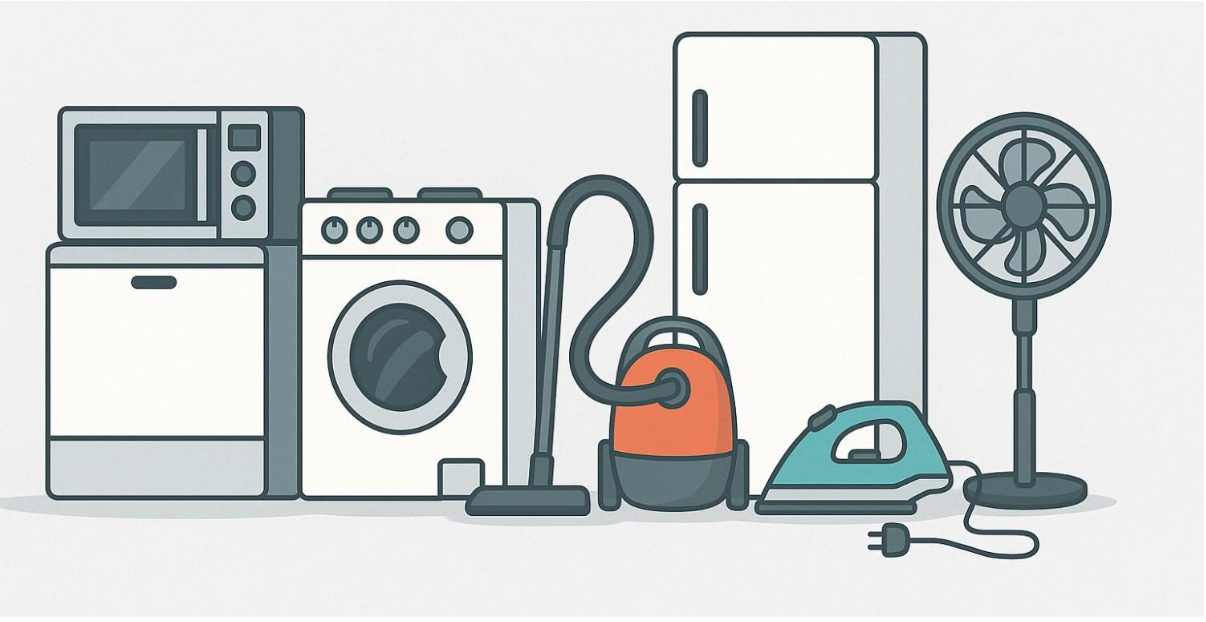
GST Impact on Domestic Appliances and Electrical Machinery The domestic appliances and electrical machinery sector underwent substantial variations after GST implementation in July 2017 . This product range blends basic household items such as air conditioners and washing machines with refrigerator options alongside food processors and ceiling fans, and many other household goods that serve numerous Indian domestic settings. The comprehensive analysis in this blog discusses the complete GST effect on domestic appliances and electrical machinery and shows how it changes business conditions and consumer situations. The post also presents GST tax levels for different appliances, along with HSN codes, while providing market trend outlines.
Understanding Domestic Appliances and Electrical Machinery The category of domestic appliances and electrical machinery includes any equipment that operates through mechanical or electrical means in home environments and commercial sites. These include:
The major appliances category includes refrigerators together with washing machines and air conditioners, and dishwashers.
Small appliances : Mixers, blenders, food processors, electric irons.
Electrical machinery includes motors, together with transformers and generators, as well as industrial fans and pumps within its category.
Goods in this category get classified under HSN Chapter 84 and Chapter 85 based on their operational characteristics.
Pre-GST Tax Regime: A Complicated Maze The taxation system operated with multiple complex components before the GST implementation. States implemented different levels of Value Added Tax (VAT) between 5% and 15%, but the central authority enforced both Excise Duty and Central Sales Tax (CST).
For example:
Excise duty on domestic appliances: 12.5%
VAT: 5%–15% (varied across states)
CST: 2%
Octroi or Entry Tax: applicable in certain states like Maharashtra
This multi-tiered tax system led to:
Cascading effect (tax on tax)
Complicated logistics and compliance
Lack of uniform pricing across India
Post-GST Scenario With the implementation of GST, most of these taxes were subsumed under one unified structure , comprising:
CGST (Central GST)
SGST (State GST)
IGST (Integrated GST)
The new structure of taxation introduced clarity while making everything more transparent and simpler for businesses as well as consumers to comply.
GST Rates on Key Domestic Appliances and Electrical Machinery The GST regulations for different appliances and machinery require analysis as follows:
Appliance/Machinery HSN Code GST Rate Refrigerators, Freezers 8418 18% Air Conditioners 8415 28% Washing Machines 8450 18% Electric Irons 8516.4 18% Mixers, Grinders, Food Processors 8509 18% Electric Fans 8414 18% Dishwashers 8422.11 18% Electric Water Heaters (Geysers) 8516.1 18% Vacuum Cleaners 8508 18% Transformers and Generators 8504 / 8502 18%
Note: Air conditioners still attract the highest slab of 28% , as they are considered luxury goods.
HSN Codes for Electrical Machinery and Domestic Appliances GST uses the Harmonized System of Nomenclature (HSN) for classifying goods. Here are the key HSN chapters relevant to this industry:
Chapter 84 : Machinery and Mechanical Appliances
Chapter 85 : Electrical Machinery, Equipment, and Parts
Examples:
HSN 8415: Air Conditioning Machines
HSN 8418: Refrigerators, Freezers
HSN 8450: Washing Machines
HSN 8509: Domestic food grinders, mixers
HSN 8516: Electric irons, toasters, geysers
Proper use of HSN codes ensures accurate GST filing, classification, and avoidance of penalties.
Impact on Consumers Pros Price Reduction (for some appliances) : In cases where the total pre-GST taxes exceeded 18%, GST brought slight price relief. Eg, washing machines became cheaper in some states.
Uniform Pricing Across India : One tax structure simplifies pricing for consumers across all states.
Transparency in Taxation : Customers can now see the GST component clearly on invoices.
Cons High GST on Luxury Items : Appliances like ACs still fall under the 28% bracket , keeping them expensive.
Increased Cost of Small Appliances : Some appliances earlier attracted VAT of 5%-12%. Now, the GST of 18% has led to a price hike in several cases.
Impact on Manufacturers and Retailers Benefits Simplified Compliance : Single return filing system through GSTN (GST Network)
Input Tax Credit (ITC) : Manufacturers can claim credit on taxes paid for inputs and raw materials (e.g., steel, plastic, copper).
Boost to Logistics and Warehousing : Removal of state-wise check-posts reduced transit time and warehousing costs.
Ease of Expansion : Uniform tax enabled manufacturers to expand easily across states.
Challenges Working Capital Crunch : Delays in ITC refunds affected liquidity.
Compliance Burden : For small retailers and traders, filing regular GST returns and understanding HSN codes is a challenge.
Input Tax Credit (ITC) Benefits The ITC mechanism has been a game changer. Here's how:
Example :
A manufacturer buys raw materials worth ₹1,00,000 and pays 18% GST = ₹18,000.
On sale of finished appliance worth ₹2,00,000, GST collected = ₹36,000.
Net GST payable = ₹36,000 – ₹18,000 = ₹18,000 only.
This reduces the overall cost and prevents cascading taxes. However, ITC is only allowed if:
The supplier has filed GST returns
Goods/services are used for business
Invoice is available
Challenges and Concerns Despite many benefits, certain challenges persist:
High GST on Essential Appliances : Items like geysers, fans, and air purifiers are necessities in many regions but are still taxed at 18%-28%.
Inverted Duty Structure : In some cases, GST on inputs is higher than GST on output, causing refund accumulation issues.
Classification Disputes : Ambiguities in HSN classification can lead to litigation or penalties.
Slow Refund Process : Exporters and manufacturers often face delays in ITC refunds.
Future Outlook The GST Council may revise tax slabs in the future to make essential domestic appliances more affordable. Some potential reforms include:
Reducing GST on fans and geysers to 12%
Reclassifying energy-efficient appliances under lower slabs as an environmental incentive
Improving refund timelines to support MSMEs
As the market for smart and IoT-enabled appliances grows, the government might bring special provisions for these segments as well.
Conclusion The implementation of Goods and Services Tax operated as a comprehensive system reform for India's taxation structure particularly in the domestic appliances and electrical machinery industry. The GST system has streamlined compliance yet supported interstate trade but keeps essential household taxes at high levels as central issues.
When purchasing or operating as a business it becomes vital to understand GST rates together with HSN codes and Input Tax Credit benefits to make informed economic choices. The policymakers should examine GST tax levels for essential household appliances because this review will enhance accessibility as well as energy efficiency and propel national economic expansion.
Want to start an online store for electrical appliances? SWIPE has got you covered!
Get your Personalised Online Store up and running today!
FAQs 1. Which GST tax bracket applies to refrigerators, along with air conditioners, in the Indian market? The GST tax on refrigerators totals 18%, but air conditioner products occupy tax categories at 28% for HSN codes 8415 and 8418.
2. Are electric fans and geysers considered essential or luxury items under GST? The taxes for essential appliances remain at 18%, although they play a crucial role in many family homes.
3. Can businesses claim Input Tax Credit (ITC) on electrical appliances used in offices? A company can claim ITC benefits only when electrical equipment serves business needs instead of personal requirements.
4. Which HSN codes apply to domestic appliances under GST? Under GST system the HSN codes encompass category 8415 for ACs together with 8418 for Refrigerators and 8450 for Washing Machines and 8509 for Mixers.
5. Has GST made home appliances cheaper or more expensive? The GST reform lowered some product costs, but ACs, along with other items, became more costly due to GST's elevated rates.
.png)
-compressed.jpg)
.jpg)


.png)
.png)
.png)
.png)