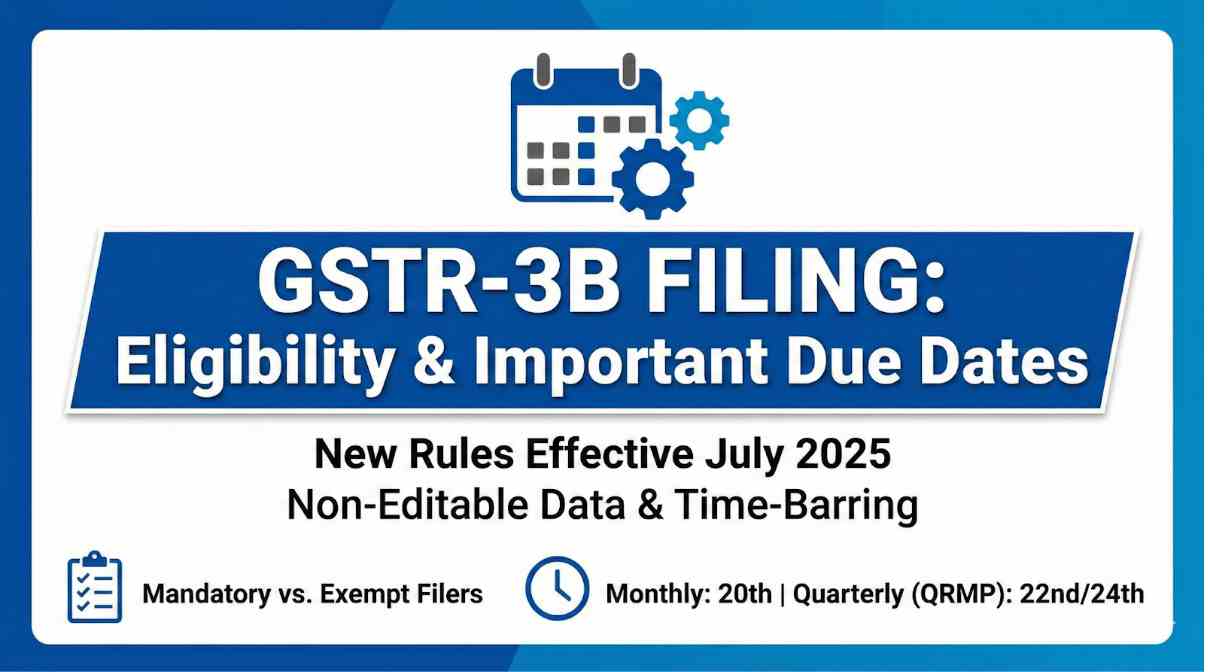
GSTR-3B Filing: Eligibility Criteria and Important Due Dates Tax compliance may sometimes feel like trying to navigate a maze while being absolutely lost. You have probably heard your "GSTR-3B" brought up in every accounting discussion if you are an Indian entrepreneur. But what actually is a "GSTR-3B," and why does it sound like an alarm going off in your head when you miss this date?
GSTR-3B is the lifeblood in the process of GST compliance. It has been mandated that each registered regular taxpayer has to file a summarized return in respect of their input tax credit (purchases) and GST liability (sales) in the GSTR-3B return. Unlike other forms, which may or may not be only informative in nature, GSTR-3B is where the actual tax payment is made. Knowing the finer points of the GSTR-3B is critical in ensuring that your business remains penalty-free no matter how much experience you may have as an entrepreneur. Now, considering the strict rules that have already come into action since July 2025, let us take a look at everything you will need.
GSTR-3B: What is it? One way to view this form is that it is the "report card" of the tax health of your business. In this form, you make the following statements:
Outward Supplies: Your total sales (exempt , taxable, and nil-rated sales).
The tax amount you paid on purchases made by your business is called the Input Tax Credit .
Tax Liability: This is the net tax that is owing to the government after your ITC has been deducted from your sales tax.
Importantly, you cannot modify GSTR-3B after you have filed it. Its "file it right the first time" characteristic makes it one of the most sensitive returns in the GST environment.
Qualifications: Who Needs to File GSTR-3B? For GSTR-3B, the government has kept the net open. You will most likely need to file this return if you have a GST registration number.
1. Mandatory Filers The return in GSTR-3B has to be filed if you are:
A regular taxpayer: This would include most firms, for example, manufacturers, traders, and service providers.
You're a casual taxable person
2. Whom Does It Exclude? If you fall into any of the following categories, then you are not required to file this form:
Composition Dealers: You instead file GSTR-4 and CMP-08 .
Input Service Distributors (ISD): You file GSTR-6. Non-Resident Taxable Persons: You will file a GSTR-5.
OIDAR Service Providers: You file GSTR-5A .
3. Return Rule "Nil" “I had no sales for the month, so I don’t have to file” is a common misconception. The statement is false. You are required to file a Nil GSTR-3B even if you have no sales, no purchases, and no transactions for the month. Failing to do so would mean that you would have to incur late fees and would also mean that you would not be able to file for returns.
Important GSTR - 3B Dates of Due (2025-2026) Your Total Turnover and the Plan you choose (Monthly or QRMP) will decide your due date for filing GSTR-3B.
1. Filers each month You are mandatorily required to submit the form GSTR-3B on a monthly basis in the following two cases: If your annual aggregate turnover exceeds the amount of Rs. 5 crores. When you specifically opt out of the QRMP Scheme.
Due Date: The 20th of next month.
For example , for the month of January 2026, the date of payment will be February 20, 2026.
2. QRMP Scheme: Quarterly Filers The Quarterly Returns with Monthly Payment (QRMP ) scheme is applicable to small taxpayers having an annual turnover not exceeding ₹5 Crore. They require filing GSTR-3B only once in every quarter, whereas they pay taxes in a monthly manner (through Form PMT-06).
The deadlines, depending on the state of registration of your business, are as follows:
The cutoff date for Category A States for South and West India is the 22nd of the month following the quarter.
The deadline of Q4 for example, would fall by April 22, 2026 - January to March 2026.
For Category B States , i.e., North & East India, the due date for return filing would be the 24th of the month succeeding the quarter.
For example, the last day of submission of Q4 is April 24th for the period commencing January – March 2026.
Important Changes It is necessary to keep yourself updated on the latest notifications coming from the government, which helps you avoid any compliance related issues. In 2025, there were two major changes in the GSTR-3B :
1. Hard-locking GSTR-3B Makes It "Non-Editable" The auto-fill data provided for GSTR-3B will be hard-locked by the GST portal from July 2025 tax periods onwards.
What this means: In earlier times, if there were discrepancies between your sales figures entered into your GSTR-3B, you had the option to change them manually. Your GSTR 1 details will be frozen in your GSTR-3B from July 2025.
Impact: You will not be able to ‘fix’ mistakes done in GSTR-1 from GSTR-3B now. Prior to submitting your GSTR-3B , you must rectify your errors via GSTR-1A.
2. Time Bar for Three Years Unfiled returns are under a strict time limit. It is not allowed to file any GST returns, including GSTR, 3B, three years after the original due date. Therefore, you have to make sure that all your extremely old outstanding returns are cleared before the expiration of this time window.
Detailed Instructions for Filing Step 1: Login and start navigating
Go to the GST Portal and log in. Then, go to Services > Returns > Returns Dashboard. Select the Month/Quarter and the Financial Year that are applicable.
Step 2: System Generated Summary
Clicking GSTR-3B will generate a "System Generated Summary." The system will display this.
Table 3. 1 (Sales): The data from your GSTR-1 is auto, populated in the form.
Your GSTR-2B is really helpful because it gets information from the filings of your suppliers. This information is then used to fill in Table 4 which is, for Input Tax Credit also known as ITC. Your GSTR-2B automatically does this for you.
Step 3: Confirm and Balance
The most critical part is to compare your account books with numbers that have been automatically generated.
Pro Tip: It’s very important to record all of your transactions accurately, and billing software such as Swipe can be very useful for that. Swipe’s invoice tracking features make reconciling much easier by giving you specific information about the status of the invoices sent out.
Confirm the Input Tax Credit (ITC) in Step Four.
Ensure that you are claiming the qualifying ITC only in Table 4. The supplier's bill will not appear in GSTR-2B if the supplier has not filed GSTR-1, and you cannot claim the ITC at this stage.
5. Payment of taxes
Verifying the details, click on "Proceed to Payment." For the account to be in balance, your Electronic Cash Ledger (credit facility in your account) will be utilized by the system. Challan (Net Banking, NEFT, RTGS, or UPI) must be utilized to clear all outstanding amounts.
Step 6: File the Return
After offsetting the obligation, choose "File GSTR-3B." These words must be accompanied with the following:
Digital Signature Certificates, or DSCs, are required for business entities and limited liability companies.
EVC (Electronic Verification Code): For sole proprietors/partnerships, an OTP is sent to the registered cellphone number.
Common GSTR 3B Mistakes that should be Avoided Experienced accountants can make errors. These are the pitfalls to avoid:
1. Incompatibility with GSTR-1 You might get a reminder of underpayment of taxes if your GSTR-3B sales figures are lower than GSTR-1. You might have paid excess taxes if your GSTR-3B sales figures exceed GSTR-1. You must check if they both match before filing due to the "Non-Editable" regulation set to be enforced in July 2025.
2. Making an Ineligible ITC Claim A typical error in disclosing ITC would be for personal expenses or disallowed credits (staff meals and drinks).
In order to segregate allowable from disallowed business expenses, always run the Create GST invoice online dataset.
3. Submitting under the incorrect heading One of them is when there is a mistake in the entry of IGST (inter-state tax) instead of CGST/SGST (intra-state tax). It has to be rectified by a lengthy process of refunds.
4. Forgetting to File "Nil" Returns As already indicated, failure to file a return in case you did not generate any business results in pointless penalties.
Conclusion Not only is it mandatory to file GSTR-3B , but it also ensures that your business is always financially stable and secure. There is no room left to procrastinate, as it is not possible with stricter norms imposed in 2025, including hard-locking of data and time barring of previous GST returns.
You can make this monthly process a seamless process of just five minutes by being organized and reconciling your data every month. Remember, it is less expensive to be GST-compliant than to pay the cost of punishment. One such way to be clever with invoices is to use Swipe.
FAQs 1. Can I revise GSTR-3B after filing? Yes, but the fact is that the form cannot be altered after its submission. But if there’s an error, the error can be corrected by adjusting the numbers reflected in the GSTR-3B of the succeeding month (as per the new hard-lock system introduced for July 2025).
2. Is GSTR-3B required if I have no sales? Yes, you have to file a Nil GSTR-3B. The late fee for not filing the Nil return is ₹20 per day.
3. Can I file GSTR-3B before GSTR-1? Technically yes, it is highly not advised. Since the values in GSTR-3B will be auto-populated from GSTR-1, the filing of GSTR-1 first ensures that there is accuracy without any data mismatch.
.png)
-compressed.jpg)
.jpg)


.png)
.png)
.png)
.png)