How GST Works for Small Businesses GST is a single, destination-based, multi-stage tax on the value addition and it is levied on every stage of value addition. GST, an abbreviation that stands for Goods and Service Tax is a tax levied on Goods and services, with value addition at every stage, having a broad and continuous chain of set off’s right from the manufacturers / Importer point up to the retailer’s level, where only the tax on value addition at every stage shall be collected with effect from 1st July 2017 at the last point of consumption.
It's India’s replacement for the indirect tax system, replacing multiple layers of taxation levied by central and state governments. The GST has potential benefits of higher exports, and higher GDP on account of efficiency gains and also can make India a common market with common tax rates and procedures thereby removing the economic barriers and paving the way for an integrated economy at the national level.
Introduction to GST for Small Businesses Maybe the simplest thing about GST for small businesses is the new tax structure that has been implemented. However, implementing the same is a challenge because the new system comes with a new paradigm for tax compliance. One needs to be aware of the 4 main tax rates; 5%, 12%, 18%, and 28%, levied based on the kind of products and services one is dealing in. It is necessary to get the rates correct so that one can make correct tax calculations and file taxes accordingly.
With the implementation of GST, many physical barriers in interstate trade have been eliminated. These included check posts at borders and inspections. Check posts were often delaying transportation and increasing costs due to corruption and inadequate bureaucratic streamlining. GST for Small Businesses has particularly been beneficial for start-ups and ordered businesses as it meant they could maintain warehouses in minimal provinces and freely move goods between states without being taxed in subsequent states.
GST Registration for Small Businesses Registering GST for small businesses is mandatory if the annual turnover exceeds Rs 40 Lakh (Rs 20 Lakh for businesses in special category states). It must also be noted that businesses having turnover of more than Rs 40 Lakh involved in the manufacturing sector that does not provide inter-state supply are under obligation to obtain GSTIN, as it enables to gather and attain credit of input tax consistently paid on input supplies. GST registration brings multiple advantages with it:
Input Tax Credit (ITC):
It enables the companies to deduct the tax payable on inputs from the total tax payable on sales and thus helps them in reducing their overall tax burden.
Interstate Sales:
GST has made interstate sales far easier and smoother, with no barriers, allowing small businesses to expand their customer base to nationwide markets.
Credibility:
GST Registration instills a sense of reliability among clients and vendors of a small business thus, helps in building credibility across all recessions.
Composite Scheme: Businesses with an annual turnover of up to Rs 75 lakh can choose the Composite Scheme under GST and pay tax at a flat rate of 1% to 5%. Other benefits of this scheme are the ease of compliance with fewer records to maintain and lower tax liability.
Step-by-Step Guide to Filing GST for Small Businesses Filing GST for small business returns can seem complex, but a structured approach can ease the process. Here's how small businesses can manage their GST filings:
1. Preparation: Collect necessary documents such as business PAN, GST registration certificate, and invoice details of purchases and sales.
2. Registration on the GST Portal: If not already registered, complete your GST for Small Business registration to obtain your GSTIN.
3. Understanding GST Returns: Depending on the business type, file the required returns such as GSTR-1 for outward supplies and GSTR-3B for monthly summaries.
4. Filing Returns: Accurately file the necessary returns through the GST portal. Ensure accuracy to avoid penalties for discrepancies.
5. Payment of GST: Calculate your tax liability and make the payment online through the portal. Timely payments are essential to avoid interest on delayed payments.
Documents and Information Needed when Paying GST for Small Business Before beginning the GST filing process, ensure you have the following documents and information ready:
1. Business PAN (Permanent Account Number)
2. GST registration certificate
3. Invoice details of sales and purchases
4. Bank statements
5. Previous GST returns (if applicable)
Step 1: You would need to register on the GST Portal What is the new procedure if you have not registered yet? You will need to provide your PAN, mobile number, email ID and state or union territory. Your temporary application only takes the form of a Temporary Reference Number (TRN).
Step 2: GST Returns Overview Types of Returns to be filed under GST for Small Businesses:
GSTR-1: Outward supplies of taxable goods and/or services details.
GSTR-3B: Summary of Outward supplies per month along with Input Tax Credit claimed or the Total tax paid
Step 3: Filing Returns – A Detailed Process GSTR-1 Filling: You must submit information about all sales transactions. You submit this form monthly or quarterly, according to your revenue.
Filing of GSTR-3B: The GSTR-3B is a month-to-month detailed report due by the twentieth of the following month. It summarizes the information on outward supplies and input credits.
Step 4: Payment of GST After returning, compute its tax payable and pay it through the GST portal. Before filing GSTR-3B ensure that payment is made on time to avoid any interest/penalties as per GST for Small Businesses.
Tips for Accurate and Timely Filing 1. Keep records of all invoices and receipts using GST-compliant accounting software like Swipe.
2. Regularly update your records to avoid last-minute hassles.
3. Stay updated with the latest GST rules and amendments, or better take the help of your financial advisor to help make the best decision around your GST for Small Business.
Enhanced Operational Insights GST for smaller businesses has compelled them to upgrade their accounting and IT systems leading to better inventory and accounts management which has indirectly improved overall efficiency and transparency across various sectors.
But on the flip side, GST for Small Businesses has caused several challenges, mostly in adapting to the new tax regime, particularly in terms of compliance costs and the need for technological upgrades.
The extra burden of having to register online in every state where you make a sale and having to file monthly returns has added too much to small-sized businesses.
Additional Tips for Efficient GST Compliance Regular Training: Regularly train your staff on GST updates and compliance requirements.
Record Keeping: Maintain detailed records of transactions, as GST requires every sale and purchase to be well-documented.
Consult Experts: Regularly consulting with tax experts can make it easier to comply with GST for Small Business.
Complying with the regulations around GST for Small Businesses can be a daunting task, which is why software like Swipe exists; for your rescue. Filing your GST returns has never been easier, making it one of the best software for businesses and individuals alike.
Conclusion and Further Resources GST has simplified tax compliance for small businesses by simplifying the operation side too, reducing headaches running businesses in multiple states, and making the tax paying process easier and simpler. This is essential because more recent updates are only valid if absorbed by small enterprises; GST-compliant companies not only meet their requirements but can also help improve their operational performance and penetrate a wider market.
These resources range from online guides that provide detailed information about GST to GST helplines that offer quick answers to questions and professional GST consultancy services that help businesses stay compliant and efficient under GST.
By adapting to and embracing GST, small businesses in India can improve their compliance, operational efficiency, and potentially their market reach.
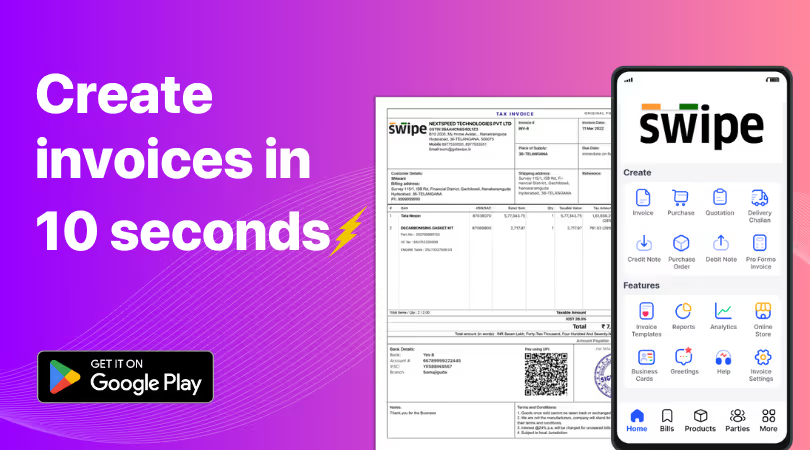
Simplifying Compliance in GST for Small Business with Swipe Every user can Create and Manage invoices in minutes to ensure compliance with tax laws and avoid penalties. The fixtures of the Swipe invoicing app are,
1. Effortless invoicing: Create invoices effortlessly with the swipe invoice app and send it to customers.
2. Direct UPI payments: Get paid instantly to your bank account with zero transaction charges using swipe’s UPI payment system. The first UPI payment system in any mobile invoice app.
3. Efficient management: Have all your invoices at a glimpse with the swipe intuitive dashboard. Easy to manage sales, purchases, and GST filings.
4. Safe and Secure: Secure billing. Swipe uses the bank-grade SSL encryption.
Combine our integrated features to automate and remind yourself of your deadline and keep your business compliant with GST for Small Business so you can ensure that your company is ready to transform its GST compliance strategy by using Swipe so that your business can stay financially healthy and continue operating efficiently, according to latest financial best practice, and maintained Your businesses regulatory compliance.
Using the integrated features in Swipe , you can eliminate the risk of your GST for Small Business payments being filed late. By using Swipe to handle your GST obligations, you are keeping your business compliant with industry requirements and legislation.
.png)
-compressed.jpg)
.jpg)


.png)
.png)
.png)
.png)