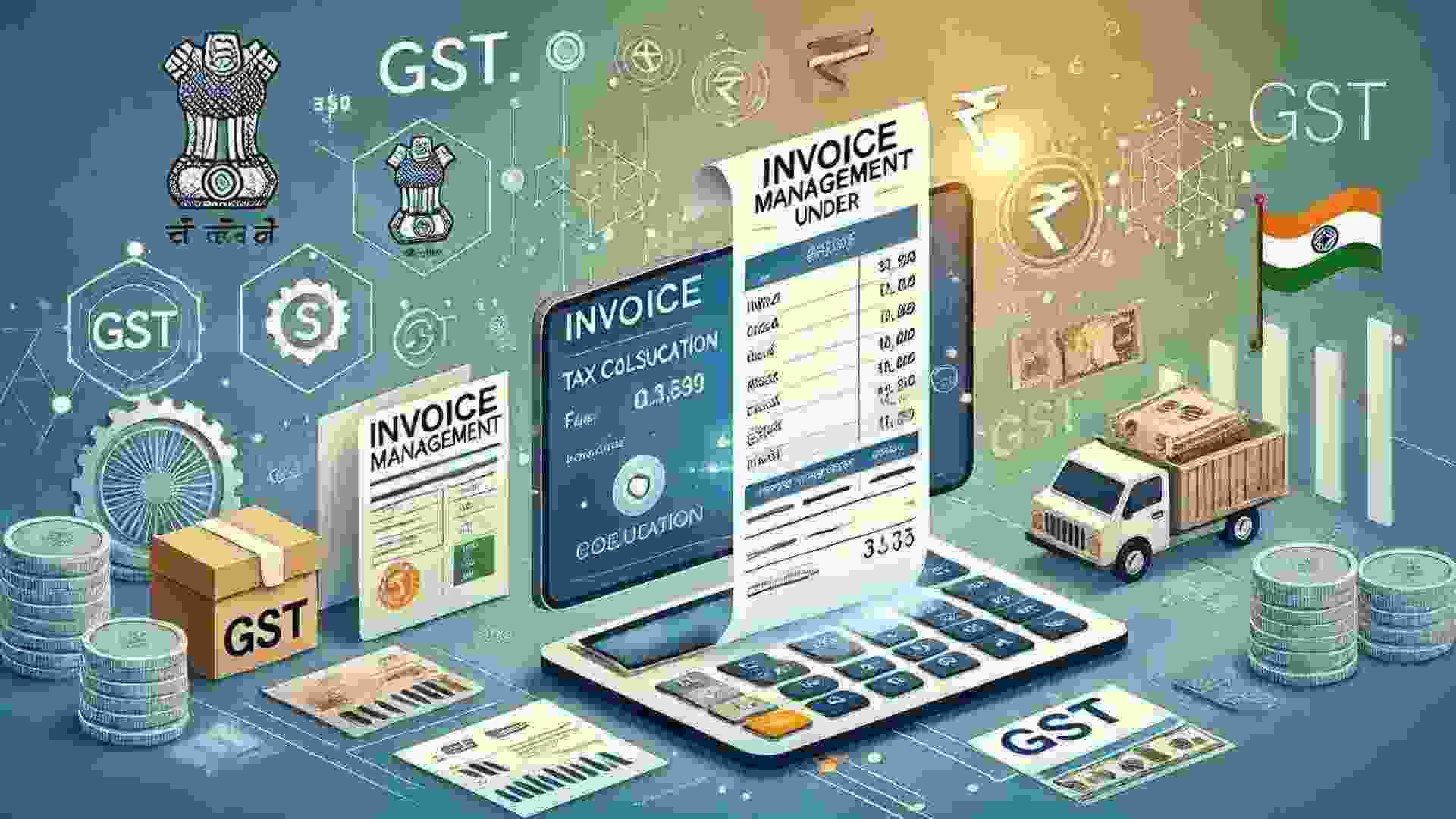
Invoice Management System under GST: Features & Benefits Under the concept of GST, the Invoice Management System under GST is a commercial enterprise which provides solutions aimed at easing, enhancing and managing the processes of drafting, tracking, and accommodating invoice(s) for businesses. With geographies across the world embracing the Goods and Services Tax, getting proper documentation and invoicing has become important for compliance with the law, claiming for input tax credit as well as for audit purposes. In this guide, we will analyze the components and advantages of the Invoice Management System (IMS) within the GST framework, and how such a system can enhance business operations’ effectiveness and compliance with GST rules.
What is an Invoice Management System (IMS)? An Invoice Management System (IMS) is an online tool developed to assist in controlling the records of invoices produced under the Goods and Services Tax. It is therefore an ideal package for organizations to create, check, maintain and monitor tax invoices that meet the requirements of the GST law.
IMS is of great importance to companies that issue and receive a massive number of invoices, documenting every transaction in a system whereby it is claimed that the transactions meet the GST legislation requirements.
Key Features of Invoice Management System (IMS) under GST The Invoice Management System is feature-rich and helps organizations manage invoices in a better manner while following certain rules under GST. Some of the key features of IMS are listed below:
GST-Compliant Invoicing One of the major services offered by the IM system is generating GST-compliant invoices. The IM system makes sure that every component of the invoice has all the information solicited by the GST laws one must include the following:
GSTIN of the supplier and buyer.
Date and number of the invoice.
Details of goods or services supplied.
Taxable value, tax rate, and GST amount.
HSN or SAC code.
This makes it less prone to making mistakes and guarantees that the invoices conform to the GST provisions, hence lowering the chances of penalties and non-compliance.
E-Invoicing Integration The e-invoicing solution, for businesses with a greater than a certain amount of turnover has become a mandatory requirement whereby any turnover goes through the Invoice Registration Portal (IRP)
Tracking Invoices In Real Time With IMS it is possible to keep a close watch on the progress of invoices at every stage from the time it is created and up to when it is paid. It makes it possible to have a look at:
Pending invoices.
Invoices awaiting payment.
Invoices uploaded to the GST portal.
This particular functionality helps organizations keep accurate records, chase for unpaid invoices and minimize possible differences after periodical reviews of the accounts have been done.
Auto-Population in GST Returns Sometimes it may be a cumbersome process to file GST returns due to overwhelming invoice uploads but IMS has a solution. It automatically fills the GSTR-1 and GSTR-3B
Reconciliation of Input Tax Credit (ITC) It is very essential to have accurate invoices for the successful reconciliation of ITC. IMS allows the identification and reconciliation of the ITC of the business with that of the suppliers by comparing the volumes billed to the volumes recorded on the ITC invoice with the invoice records available on the GST portal. This enables businesses to seek the right amount of ITC and thus the instances of miscalculating or mischarging ITC are limited.
Bulk Invoice upload/download option IMS possesses the capability of utilizing the bulk invoice upload and download option for organizations that process high volumes of transaction throughput. This is more so useful when it comes to filing GST returns as the time and effort taken to handle the invoices is greatly reduced.
Error Detection and Correction IMS is also capable of locating mistakes or discrepancies in the invoice documents such as TINs and tax amounts among other details, before submissions through the portal. The system does not allow the submission of invoices that have faults in the documents but encourages outlining them for rectification.
Secure Storage of Invoices IMS offers all the received invoices a safe place for keeping records with the view that it may be of help businesswomen may need it in the course of walking through parastatal audits or disputing with clients. Additionally, the system scrupulously follows the requirements under the GST law regarding the retention of invoice records for the mandatory period.
Benefits of Invoice Management System under GST (IMS) There are numerous beneficial sides to maintaining an Invoice Management System under GST which go from increasing the operating efficiency to maintaining compliance with GST. The chief benefits are:
Streamlined Invoicing Process IMS eliminates the manual processing of the complete invoicing cycle including the preparation of invoices that are compliant with the GST as well as the return filing. This spares the businesses from over-dependence on manual force, hence minimizing some errors along the way and managing adherence to GST policies.
Improved Compliance Performing an invoice justification and approval process ensures that such invoices are approved and reasons for their non-compliance are addressed. Therefore, having an IMS saves any software-related drawings and fines that may be due to non-conformance with the guidelines. Even just combining e-invoicing has increased compliance vindicating the process of invoicing.
Faster and Accurate Return Filing IMS auto-populates invoice data into GST return forms, speeding up the return filing process
Improved Cash Flow Timely taking the activity of invoice settlement helps the business to have outstanding invoices fettered without delays and follow up of clients in a more effective way. This serves to enable more effective management of cash flows by ensuring that cash inflows are made within the required duration.
Effective Management of the ITC In a perfect world, all invoices issued to a consumer are posted to the company's accounts and the correct amount of Input Tax Credit (ITC) is claimed resulting in very few issues during reconciliation. IMS can track and match the ITC claim with the invoice from the supplier so that the business does not miss taking credits where eligible.
Enhanced Transparency and Record-Keeping IMS offers a single platform for keeping, organization and retrieval where all documents relating to invoices only are to be kept allowing businesses to access documents when the need arises. Safe storage and quick access to the invoices enable the companies to keep them ready for any eventualities of audits or litigations.
Reduced Risk of Errors Thus, IMS helps to lower the probability of mistakes from human input by making the issuance of invoices and filing returns automated. This reduces the chances of calculating tax payable incorrectly and also solving disputes in that the wrong invoices do not match leading to penalties or time wastage in making claims for ITC.
How Does an Invoice Management System Work? As per GST, there is ease for professional societies to help businesses reconcile their inward and outward supplies efficiently with the help of the Invoice Management System (IMS). The taxpayer dashboard is where a taxpayer can look at their invoices, accept or reject an invoice or leave it in a pending state. Invoices posted by suppliers are available in real-time which enables businesses to take care of their Input Tax Credit (ITC) in a precise manner. The organization aims to accept any invoice that has not been attended to automatically before the generation of GSTR-2B to comply with the norms and minimum differences between businesses.
Date of Implementation of Invoice Management System under GST The IMS was started during the period when the GST portal used for all tax-related platforms was up and running and in use which was October 1, 2024. From the 14th of October 2024, invoices were managed and protected as taxpayers were beginning to manage their payments. The first generation GSTR-2B
Invoice Management System (IMS) Dashboard The Invoice Management System (IMS) interface is comprehended as comprised of controls necessary for the issuance and the acceptance of taxes: taxes for supplies inwards(invoices from suppliers received) and taxes for supplies outwards with customers (invoices issued to clients and received). The inward supply is the section that has been made operational and there are functions such as accepting rejected invoices that are in the business's records but for one reason or another were not attended to.
How Taxpayers Manage Invoices and Claim Input Tax Credit Taxpayers actively use the input management system (IMS), which provides services for matching dispatched supplies against invoices. Specifically, they validate the incoming invoices against the suppliers’ invoices which were submitted to the system. Invoices which are accepted can be used for ITC claims while invoices which have a mismatch can be flagged to prevent incorrect ITC claims. The IMS therefore enhances efficiency, reduces manual errors, enables timely filing of returns and record-keeping, and automates the majority of the reconciliation processes making compliance much easier. This enables businesses to maximize their insights on ITC and comply with relevant tax record-keeping standards.
Conclusion The Invoice Management System (IMS) under GST is very relevant to the business of conducting normal business management in enabling efficient compliance with paperwork and the whole process. Generation, validation and filing of invoices as a form of payment where clubbed in the Invoice Management system increases operational efficiency while reducing risks of errors. Managing invoicing under GST, whether it's for compliance with e-invoicing, reconciling ITC with related documents or filing GST returns, is one of the business solutions for managing invoicing under the GST environment.
FAQs What is the Invoice Management System (IMS) under GST? An Invoice Management System (IMS) is a technology solution enabling the generation, administration, and retrieval of invoices that are compliant with GST regulations. The place of this system is in e-invoicing as well as other compliance solutions through the GST portal.
How does IMS help in filing GST returns? Every billed invoice within IMS has some data that is worth recording in tax returns like GSTR-1 and GSTR-3B returns. Retrieval of these billed invoices mitigates manual work while completing the tax returns.
Can IMS be used for e-invoicing? Yes, IMS comprises an e-invoicing module, which gives the option to users to create and validate invoices with the IRN number captured and stored.
How does IMS improve Input Tax Credit (ITC) reconciliation? IMS assists companies in verifying searchable images against the AP and supplier activity within the GST hub to record accurate ITC claims.
Is it mandatory to use IMS for invoicing under GST? IMS is not a much-loved apprehension on the functioning of the system, though on few organizations and magnitude of Volume of invoices, it is intuitive that the use of IMS will ease the processes of compliance, invoicing will be automated, and fewer errors are likely.
.png)
-compressed.jpg)
.jpg)


.png)
.png)
.png)
.png)