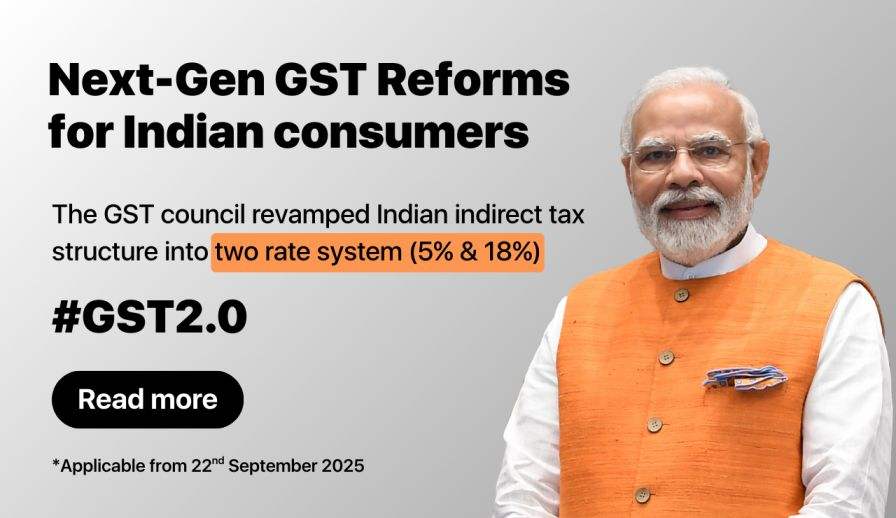
Next-Gen GST Reform: A Historic Diwali Gift to Empower India The Indian government announced that the next Goods and Services Tax (GST) regime is undergoing a significant makeover, as a “Historic Diwali Gift for the Nation.” During the 56th GST Council Meeting chaired by Finance Minister Nirmala Sitharaman, the council approved simplification of the GST framework by approving a two-slab framework, with only two GST rates of 5% and 18%. There is also a special tax bracket of 40% for sin and luxury items. The simplified tax structure is now set to go into effect on 22 September 2025, just before the festive season. This effort is intended to streamline tax rates, make compliance easier, and further Aatmanirbhar Bharat for improved ease of living, support for Micro, Small, and Medium enterprises, and economic recovery. Read the full Recommendations of the 56th Meeting of the GST Council Here!
First rolled out in 2017, the GST system created a system of indirect tax that standardised all markets under four tax brackets of 5%, 12%, 18%, 28% as well as 0-rated and exempt categories. As time progressed, the multiple-tiered structure resulted in complexity and compliance obligations.
Recognising this picture, Prime Minister Narendra Modi, in his Independence Day speech, spoke to an impending "Diwali Gift" GST reform that was going to simplify the structure, reduce GST rates on essential goods, reduce burdens on small businesses, improve demand, particularly post-COVID, with pressing global economic conditions.
Summary Table: Key GST Rate Changes Also Read: Key Features of GST: Simplifying India's Taxation System
Key Benefits for Citizens and Businesses This reform targets significant tax rationalisation across multiple areas, ensuring fair taxation of everyday products, health care, education, farming, cars, and electronic equipment making it affordable while also improving ease of doing business.
Lower Tax Burden Daily Essentials Goods such as hair oil, toothpaste, soaps, dairy spreads, utensils, and baby products have seen their GST cut from 12% or 18% to 5%.
Healthcare Products such as diagnostic kits, thermometers, medical oxygen, and corrective spectacles are now at 5% GST, and health and life insurance have moved to 0% GST.
Education Supplies Maps, notebooks, pens, crayons, and erasers are now tax-exempt (0%), which lowers the costs for students and their families.
Agriculture Tractors, tractor parts, drip irrigation systems, biopesticides, and cultivation machinery have all gone from 12% or 18% to the 5% category.
Automobiles Small petrol, diesel, CNG, and hybrid cars (within the specified engine limits), motorcycles (engine capacity of ≤350cc), three-wheelers, and goods transport vehicles have all gone from 28% to 18% GST.
Electronic Appliances Air conditioners, TVs (over 32”), monitors, projectors, and dishwashers are now taxed at 18%, instead of 28% (the rates were reduced as well).
Vision for the Future Prime Minister Modi summed up the spirit behind the initiative, stating:
"The next generation of GST reform is a gift to every Indian this Diwali. Taxes for the common people will be dramatically easier. Our MSMEs and little entrepreneurs will benefit enormously. Everyday products will be cheaper, and this will give a new jolt to the economy." This reform establishes a definitive turn towards simplified indirect taxation, fairness, and enhanced support for ordinary citizens and small businesses, the vision for a self-reliant (Aatmanirbhar) India.
Read More About: GST Cess in India: Rate, Applicability, and Calculation Explained
FAQs 1. What is Next-Gen GST Reform? A simplified GST structure called the Next-Gen GST Reform was introduced in the spirit of the Diwali 2025 GST gift, and reduced tax rates on essential items, healthcare, education, agriculture, automotive, and electronic products.
2. What are the GST types under the Next-Gen GST Reform? This introduces two main GST rates, which are 5% GST and 18% GST. There is also a 40% GST sin tax for luxury items and products that contribute harm.
3. How does Next-Gen GST Reform provide value to day-to-day essential items? Day-to-day essentials, such as shampoo, toothpaste, ghee, and baby goods, are now 5% GST items and have reduced household expenses.
4. How will reducing the GST rate affect healthcare? Healthcare items such as medical oxygen, diagnostic equipment, and corrective eyewear are subject to either 0 or 5% GST, which makes healthcare more affordable.
5. Will the GST rate changes impact education? With the revised GST structure, notebooks, pencils, maps, and erasers are now GST-free at all levels, which is another way to support affordable education.
6. How does the Next-Gen GST Reform benefit farmers and MSMEs? Farmers will benefit from reduced costs, as agricultural machinery, drip irrigation, and tractors are subject to 5% GST, whereas MSMEs will benefit from a simpler GST compliance reform.
7. What GST benefits are there on automobiles? Automobiles like smaller cars, motorcycles (350 cc and lower), and three-wheelers all come under 18% GST rather than 28%.
8. What happened to electronic appliances with the reform? Electronics appliances like air conditioners, televisions above 32” and dishwashers. All come under 18% GST, saving consumers money.
9. Will GST compliance reforms change the way businesses operate? Businesses should benefit from quicker registration (in three days) Supreme Court's GST VD, simpler refund process. The compliance reform makes it easier for citizens to live or run a business.
10. Why is the Next-Gen GST Reform a Diwali GST gift? It is a Diwali GST gift because it provides citizens with cheaper life essentials with lower GST on key sectors, and a two-slab GST that makes overall life simpler for citizens during Diwali.
.png)
-compressed.jpg)
.jpg)


.png)
.png)
.png)
.png)