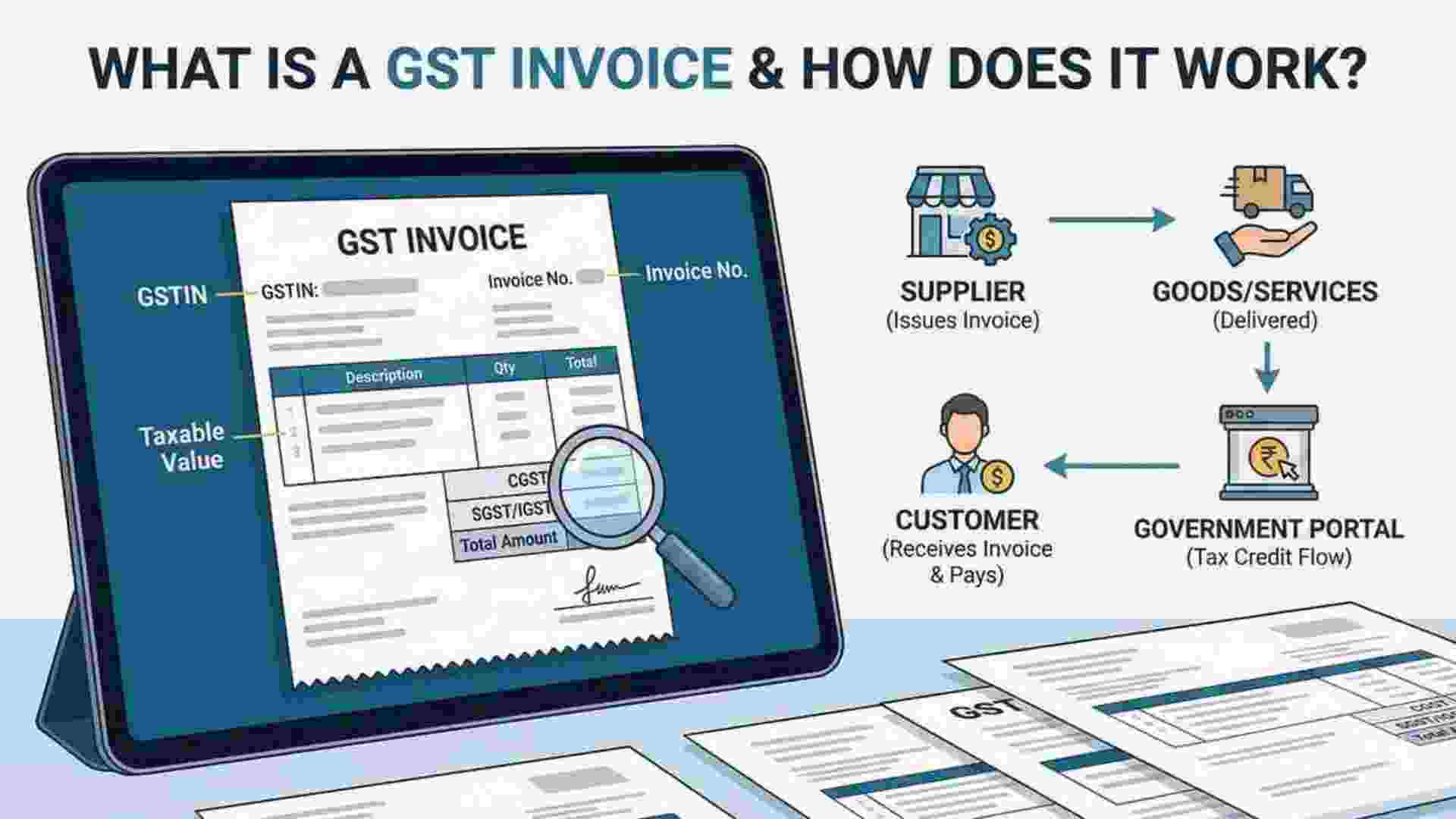
What is a GST Invoice and How Does It Work? Having a business in India based on GST, the correct invoice is not just paperwork. It lies on the foundation of tax compliance. A GST invoice must support every sale, every service, and every taxable supply. Bear in mind the invoice and keep a record of the transaction to facilitate reporting of the tax.
A GST invoice is the official receipt that makes certain that a supply of services or goods has taken place and displays the amount of tax on transactions on that transaction. This is incredibly necessary to the seller and the buyer since both of them can use it to monitor the taxes they need to pay, and the buyer can claim the Input Tax Credit . Having an idea of the mechanisms of GST invoices assits businesse in keeping proper records, being free of penalties, and avoiding difficulties when filing the GST.
Why are GST Invoices Important? GST invoices are at the heart of the whole system of GST. They connect sellers, buyers, and the tax system through documented transactions. The following are the primary causes of the importance of GST invoices.
Ensures legal tax compliance Every taxable supply must be supported by an invoice. It acts as proof that GST has been charged and reported correctly.
Helps claim Input Tax Credit (ITC) Companies that buy goods or services are only entitled to claim a tax break on the purchase when they possess a valid GST invoice.
Supports GST return filing GST returns include GSTR-1 and GSTR-3B , which are populated with the details in invoices. Without due invoicing, businesses would lose the benefits of using ICT, and they could pay fines in the process of audits or assessments.
Mandatory Details in a GST Invoice Under the GST law, the content of the tax invoice is well stated. The absence of these details may invalidate the invoice against taxation. The main elements that are required in a GST invoice are listed below.
Types of GST Invoices Not all transactions use the same type of invoice. GST law defines different documents depending on the nature of the transaction.
Tax Invoice A tax invoice is issued where the registered business is selling goods or services that are subject to tax. It is the popular invoice that is used by businesses.
Bill of supply A bill of supply is issued by businesses that cannot charge GST. This includes:
Composition scheme taxpayers Businesses dealing in exempt goods or services Since GST cannot be charged in these cases, the document does not include tax details.
Debit Note A debit note is issued when the seller needs to increase the value of a previously issued invoice. This may happen due to price revisions, additional charges, or underbilling.
Credit Note A credit note is issued when the invoice value needs to be reduced. Common situations include:
Product returns Discount adjustments Overcharging in theoriginall invoice Credit notes help correct the tax liability associatewithht the original transaction.
How GST Invoicing Works The GST invoicing is a well-organised process, which guarantees compliance and reporting in taxes.
1. Supply of Goods or Services
When a business supplies goods or services to a customer, the transaction becomes taxable under GST.
2. Issuing the GST invoice
In issuing an invoice, the seller will need to issue a GST invoice within the stipulated time:
For goods: before or at the time of removal of goods For services: within 30 days from the date of supply 3. Charging GST
The seller calculates GST based on the applicable tax rate and adds it to the invoice. The tax may be:
CGST+SGST for infrastructure transactionsIGST for interstate transactions 4. Recoding the invoice
The invoice details are recorded in the business accounting system and included in GST returns.
5. Buyer Claims Input Tax Credit
If the buyer is registered under GST and the purchase is for business purposes, they can claim input tax credit based on the invoice. The credit reduces the buyer’s overall GST liability.
E-invoicing and Digital GST Invoices The introduction of e-invoicing means that a lot of companies generate invoices via the GST portal. The characteristics of e-invoicing imply that invoice information gets uploaded to the invoice registration portal (IRP) , which creates an invoice reference number (IRN) and a QR code. The system assists the government in monitoring the transactions in real-time and minimising tax evasion. Today, e-invoicing is applied to enterprises that pass certain turnover limits.
Conclusion A GST invoice does more than document a sale. It connects every transaction with the GST compliance framework. The invoice is crucial in the transparency of the tax system, as calculated taxes and an Input Tax Credit are made possible.
To the businesses, proper GST invoicing results in ease of submitting the returns, accounting properly, and a lower chance of penalties. With the development of the GST regulations and the introduction of e-invoicing, the structure of the invoicing process only become more significant.
CLICK HERE SWIPE!
FAQs 1. What is the difference between a GST invoice and a bill of supply? An invoice contains tax specifications and is issued when a taxable supply is involved, whereas a bill of supply is issued when it is not possible to impose tax in the form that is charged.
2. Is issuing a GST invoice mandatory? Yes. All registered taxpayers are required to give out a GST invoice for taxable commodities or services that have to be provided to consumers.
3. Can a GST invoice be revised? A GST invoice is, however, not fixable once issued. They can, however, be corrected in terms of debit notes or credit notes.
4. At what time is an invoice of the GST to be made? In the case of goods, an invoice has to be made during the removal of goods or before the removal of goods. In the case of services, it has to be issued within 30 days of the date of supply.
5. What should no issue with GST invoices? Failure to present a GST invoice might attract penalties under the GST law as well as limit the buyer’s ability to claim Input Tax Credit.
.png)
-compressed.jpg)
.jpg)


.png)
.png)
.png)
.png)