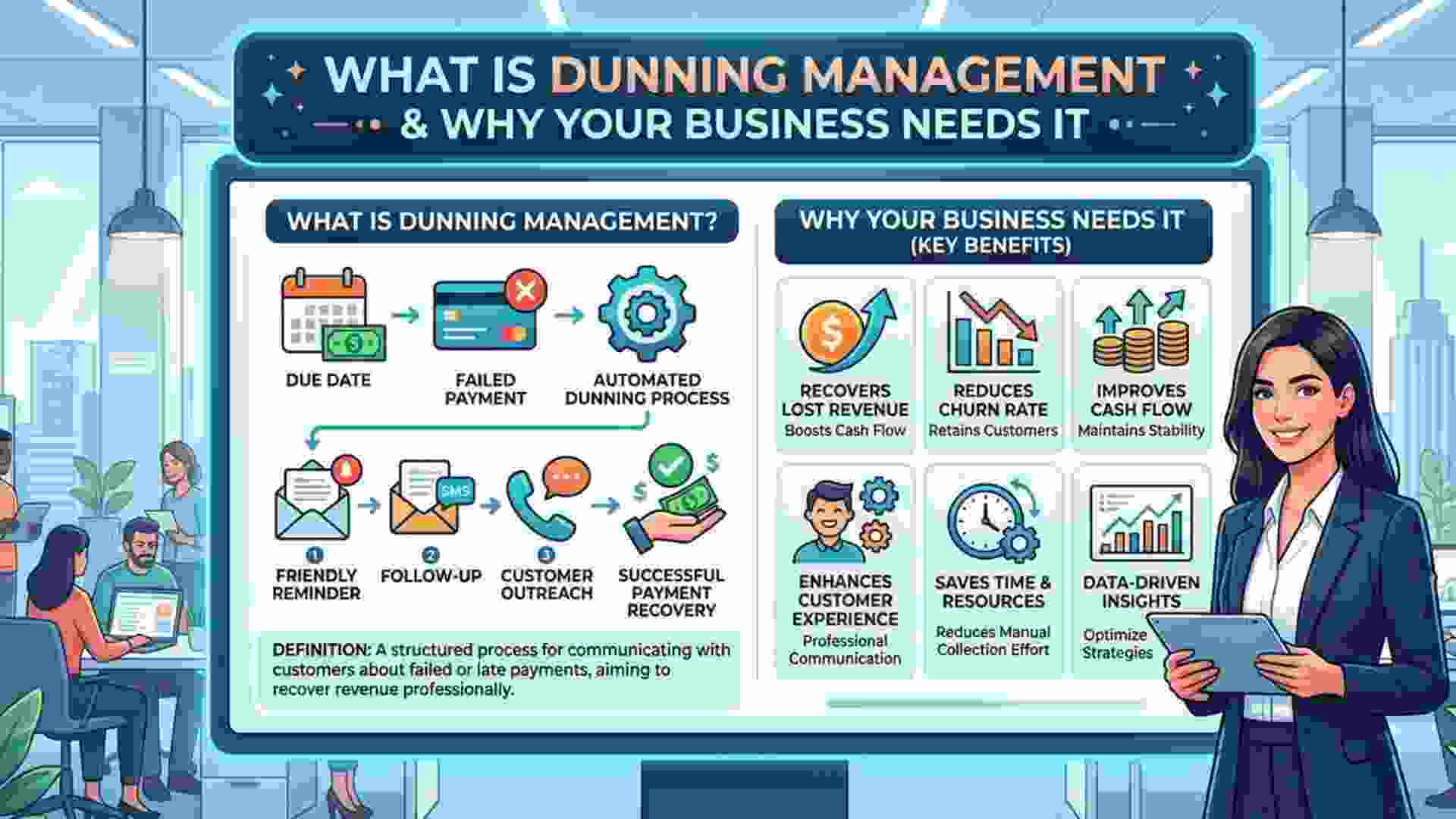
What Is Dunning Management and Why Your Business Needs It? In the world of subscription-based businesses, few challenges are as financially damaging as failed payments. A customer whose card has expired or whose transaction has been declined does not necessarily intend to leave — yet without a structured response, the business loses revenue and the customer disappears. Dunning management exists to solve this problem. It is a systematic, often automated framework for responding to payment failures, recovering revenue, and preserving customer relationships. This article explains what dunning management is, how it works, and why every recurring-revenue business needs it. Understanding Dunning Management What It Means Today Nobody updates their card the moment it expires — life gets busy, and these things are easy to miss. When a payment fails, it rarely means a customer wants to leave. Most of the time, they do not even know anything went wrong. That is where dunning management comes in. It spots the failed payment, reaches out to the customer, gives them a simple way to fix it, and retries the charge at the right time — all without the business having to chase things down manually.
What makes it work is the mindset behind it. A missed payment is almost never a red flag — it is usually just an expired card or a forgotten billing update. When customers receive a clear, calm message that makes it easy to sort things out, they do. Not because they were pressured, but because the business made staying simple.
Read More About: Business Classification & KYC Documentation Explained
How Dunning Management Works Core Components A good dunning system works quietly in the background. It catches the failed payment, notifies the customer, retries the charge at the right moment, escalates if needed, and handles the account if nothing gets resolved. Five steps working together so nothing slips through the cracks.
The Dunning Communication Sequence Stage Timing Method Tone & objective 1 1–3 days after due date Automated email Friendly — assume oversight 2 7–10 days after due date Email and SMS Polite urgency — request action 3 14–21 days after due date Email and phone Firm — highlight service impact 4 30+ days after due date Formal notice Serious — outline consequences 5 45–60 days after due date Final notice Escalatory — collections or suspension
Smart Payment Retry Logic Retrying a failed payment at a random time is little better than guessing. Smart dunning systems look at why the payment failed, what day and time tends to work best, and the customer's payment history — then pick the moment most likely to succeed. The difference in recovery rates compared to a basic fixed schedule is significant.
Dunning Management Versus Traditional Collections Feature Dunning management Traditional collection Approach Automated and proactive Manual and reactive Customer Relationship Preserved and respectful Often adversarial Timing Early — triggered by billing events Late — after significant delay Recovery Rate Typically 60–85% Typically 20–40% Scalability Easily scalable Requires proportional staff growth
Traditional collections engage only after a debt is significantly overdue and the relationship is already strained. Dunning management intervenes within days of a payment failure, when the customer is still engaged and recovery remains straightforward.
Why Your Business Needs Dunning Management Reducing Customer Acquisition Costs Winning a new customer costs far more than keeping an existing one. So when someone leaves simply because a payment failed and nobody caught it in time, that loss hits twice — lost revenue and the cost of finding a replacement. A single well-timed message could have prevented it. That is exactly what dunning management is there for.
Improving Customer Lifetime Value Every month a customer stays is another month of value built. When a subscription ends not by choice but because a payment slipped through unnoticed, that value gets cut short unnecessarily. Recovering that payment before it reaches cancellation is one of the simplest ways to protect customer lifetime value.
Maintaining a Positive Customer Experience How that recovery is handled matters just as much as whether it happens at all. A clear, considerate message with a simple way to resolve things can actually strengthen the relationship. But poorly handled dunning — confusing notices or a sudden account suspension — pushes customers away even when they had every intention of staying.
Supporting Compliance and Governance In regulated markets, how a business communicates about overdue payments can be a legal requirement, not just good practice. A documented dunning process shows that communications are transparent, timely, and fair — keeping regulatory risk well under control.
Also Read About: Types of Business Software Every Small Business Needs
Dunning Management for Different Business Models SaaS businesses need to treat enterprise and consumer accounts differently — high-value clients deserve a more personal touch and earlier human involvement. E-commerce subscriptions add another layer, where a failed payment can disrupt an upcoming delivery before anyone realises what happened. For media and content platforms, speed is everything — a customer who loses access will find an alternative fast, so communication needs to be immediate and frictionless.
Choosing a Dunning Management Solution Building a dunning system from scratch sounds appealing, but it takes significant engineering time and ongoing maintenance. A purpose-built platform skips all of that — ready to go, with smart retry logic, A/B testing, and analytics already built in. For most businesses, it is simply the smarter place to start.
Whatever the choice, the solution needs to work seamlessly with the existing payment gateway, CRM, and subscription platform, and surface clear reporting so the business always knows what is working and what needs adjusting.
Conclusion Most Customers Who Don’t Pay Don’t Want to Leave — They Just Need a Nudge at the Right Moment. When companies manage this well, they not only recapture revenue and eliminate unnecessary churn; they also build relationships with staying power. Tools like Swipe lets you do all that with dunning management easy and automated payment retries, customer communications and recovery workflows in one place.
FAQs What is dunning management? Dunning management refers to a process for automating the collection of delinquent accounts by sending collections notices automatically, retrying to collect payment, and contacting customers.
Why do payments usually fail in subscriptions? Most payments that fail are due to expired credit/debit cards, bad checks, or invalid billing information—not because the subscriber has chosen to terminate their subscription.
How does dunning management improve revenue? Dunning Management will prevent loss of revenue due to missed payments, thereby reducing involuntary churn (cancellation of subscription from lack of payment) and preserving recurring revenues.
Is dunning management better than traditional collections? Dunning Manage-ment is more proactive; it is customer-friendly; therefore, it leads to higher rates of recovery and better long-term relationships with customers compared to reactive collections.
Can dunning management be automated? Yes; there are many modern systems that have some or all of the features to automate collections such as automated retries for payments, notifications, and workflows. Thus, dunning management is easier and has greater reliability than traditional collections.
.png)
-compressed.jpg)
.jpg)


.png)
.png)
.png)
.png)