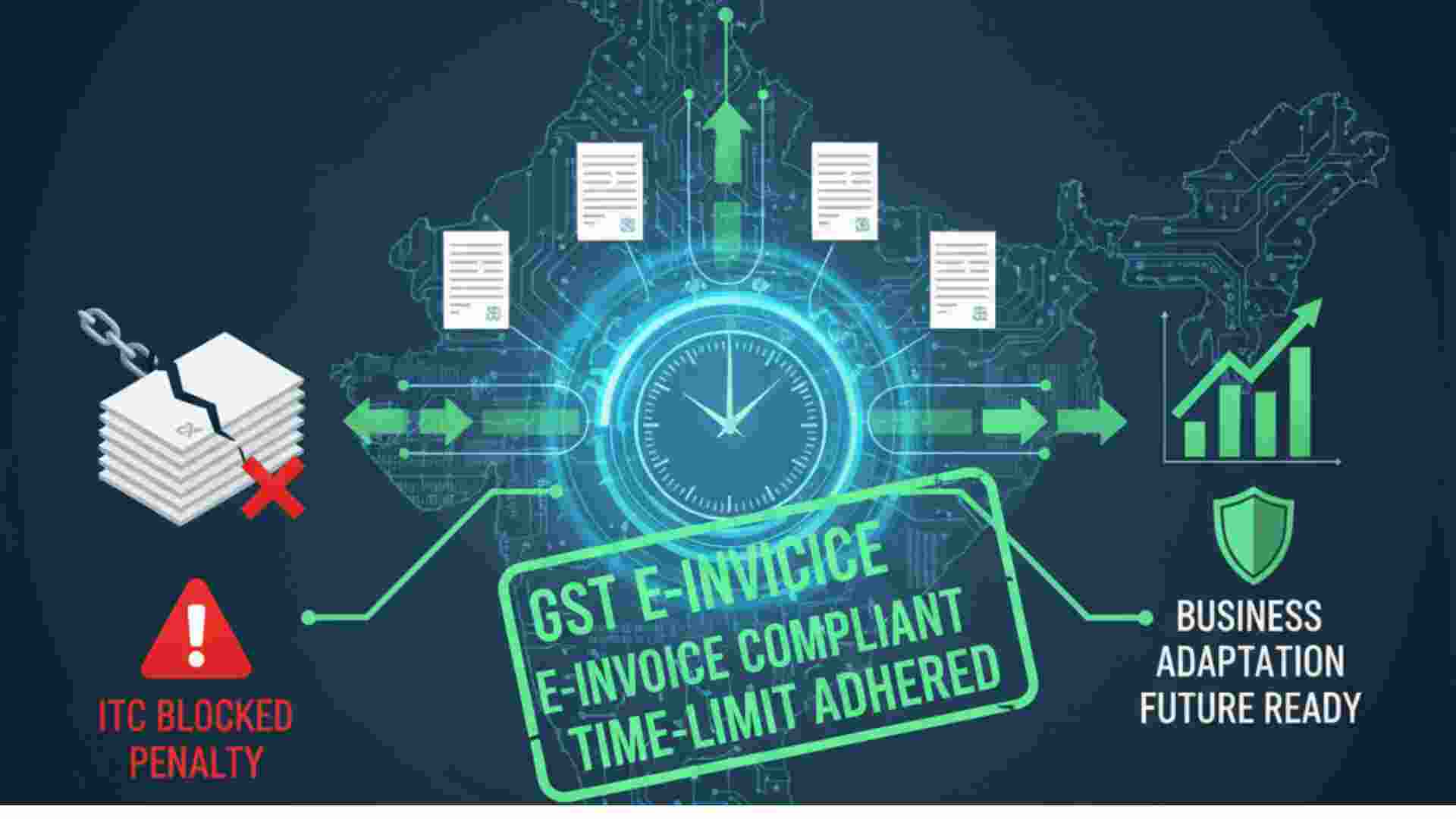
E-Invoice Time Limit under GST: Recent Notification Clarified For Within India's GST context that is continuously changing, e-invoicing has emerged as a stronghold of compliancy. Launched initially to make reporting simpler and prevent tax evasions,today it gets an additional significance — reporting time-limit for e-invoices. Let us get to know the new e-invoice time-limit notice, how it functions, its consequences, and how businesses can adapt to be ahead in the game.
What is an E-Invoice in GST An e-invoice is a computer-validated invoice generated by the government's invoice Registration Portal. On verification, every invoice is provided with a distinct Invoice Reference Number(IRN) and QR code for verification. All B2B invoices are therefore onboarded digitally in the GST regime in real-time — transparent and stopping tax leakage. Refer Here: All about E-invoice in GST
E-invoice Time Limit: Latest Notification(2025 Update) CBIC has made it mandatory to follow a rigid timeline of invoice reporting under GST.
Category Effective From Aggregate Turnover(AATO) Time Limit TO Upload on IRP Large Enterprises 1 Nov 2023 ₹100 Crore and above 30 days Mid-Sized Businesses 1 Apr 2025 ₹10 Crore and above 30 days
Source: CBIC Official Advisory
Practically, every invoice, debit note, or credit note must be reported within 30 days from the issue date to IRP. Once the time limit expires, the system will have an auto block after this period for uploading.
Example of E-Invoice Time Limit Rule Invoice Date Last Day for Upload to IRP Status After Limit 1 April 2025 30 Apr 2025 Allowed 2 April 2025 2 May 2025 Allowed 31 March 2025 30 April 2025 Allowed 28 February 2025 30 March 2025 Expired — Cannot Upload
Any document older than 30 days old will be rejected by IRP and no IRN will be generated.
Why has the CBIC brought in the 30-Day Rule? Introduction of time-limit to supply GST data more real-time and genuine.
Main reasons being: Reducing delayed uploads: Ensures invoice registration almost on the transaction date. Avoiding back-dating of invoicing: Averts forgery of ITC claims. Improving data integrity: Strengthens audit trail for GST officials. Increased transparency: Allows faster synchronization of supplier and recipient details. Who Needs to Comply with the E-Invoice Deadline? Companies with an Aggregate Annual Turnover (AATO) of more than ₹10 crore in any given year on or after FY 2017-18 need to comply from April 1, 2025.
Effect of the Time Limit on Businesses The legislation simplifies the billing and ERP management process by companies.
1. Real-time Data Upload Invoices need to be created and uploaded within time frames, typically in company billing periods.
2. ERP & Software Integration Businesses must input billing software into the IRP directly for automatic uploads.
3. Real-Time Reporting Pressure Late manual invoicing can now result in rejection and compliance.
4. Refinements in Internal Control Finance teams must have automated invoice date checks and IRP uploads staying uniform.
Penalties for Being Outside the 30-Day Time Limit Being late with e-invoicing has serious repercussions:
Consequence Impact Invoice Rejection The IRP will automatically reject invoices older than 30 days. No IRN Generation Without IRN, the invoice is invalid under GST law. ITC Denial Buyers may lose input Tax Credit (ITC). Compliance Penalties Non-compliance can trigger GST audit flags. Cash Flow Disruption Delays in billing and collection cycles.
Key Benefits of Early E-Invoice Upload Benefit Description Faster ITC Claim Timely uploads ensure early reflection in GSTR-2B Compliance Confidence Reduces audit risk and legal exposure Operational Efficiency Automation cuts manual effort Better Vendor Relations Ensures your buyers can claim ITC on time.
Conclusion The 30-day e-invoice deadline is a landmark in the journey of GST compliance in India. With having real-time data integrity and backdated checkpointing invoices, it provides confidence throughout the supply chain.
FAQs 1. What is the new e-invoice time limit under GST? You must notify the invoices to the IRP within 30 days of issue date.
2. Who does this apply to? To businesses with AATO of ₹10 crore and more from 1 April 2025.
3. What if an invoice is issued after 30 days? It will be refused by the IRP and no IRN will be issued — making the invoice invalid.
4. Is the rule applicable to all types of invoices? Yes — tax invoices, debit notes and credit notes issued under B2B transactions.
5. Is the rejected invoice under the rule re-issuable? Yes, with a fresh invoice number and within 30 days from the date of re-issue.
.png)
-compressed.jpg)
.jpg)


.png)
.png)
.png)
.png)