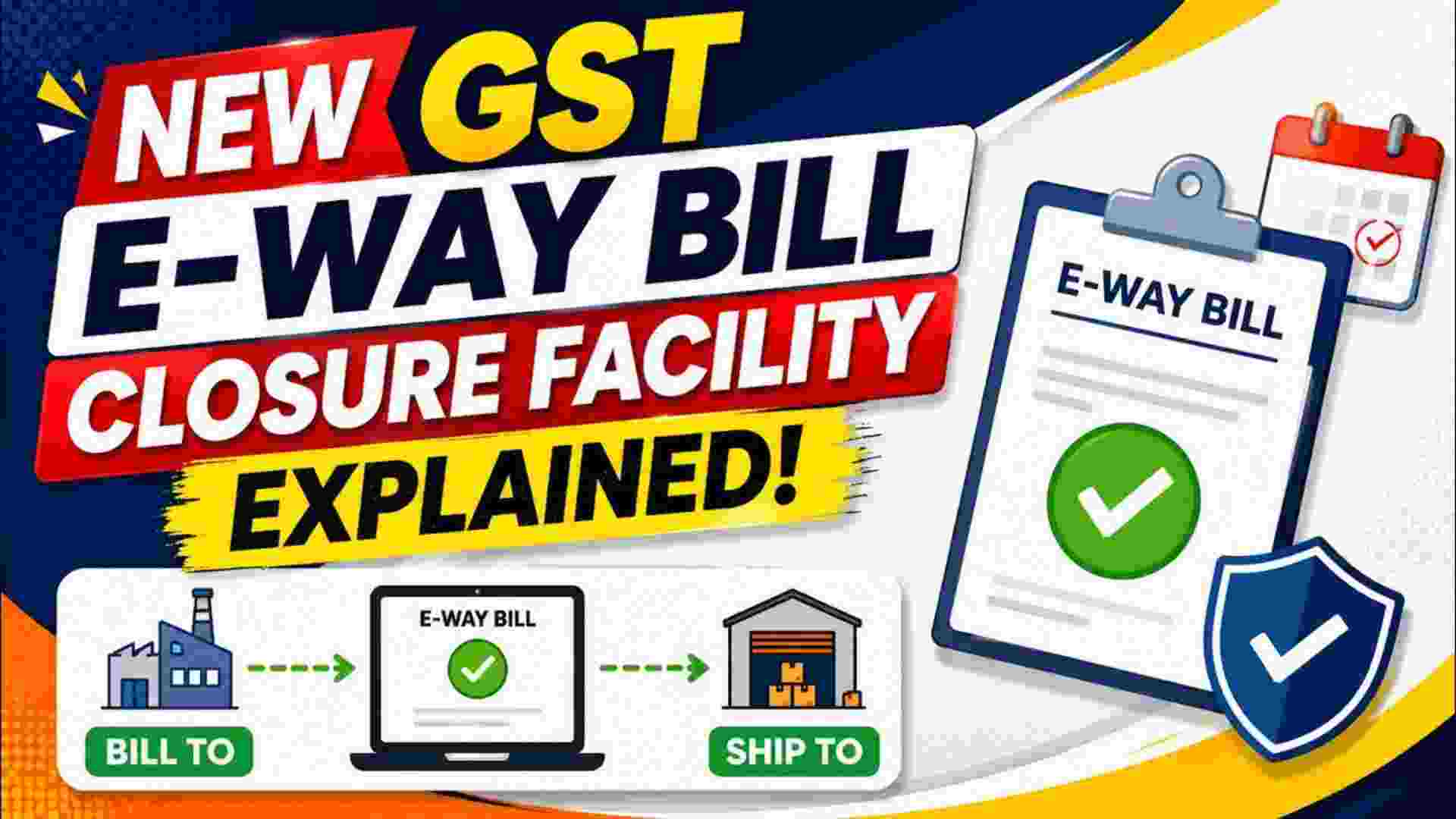
E-Way Bill Closure Facility Explained: How Suppliers, Transporters, and Recipients can Close EWBs The E-Way Bill Closure Facility allows an E-Way Bill to be marked as closed after the goods have been delivered. It can be used by suppliers, recipients, transporters, drivers and authorised persons. This facility helps businesses confirm completed goods movement and maintain cleaner E-Way Bill records. Introduction The E-Way Bill System is set to receive a significant enhancement via the introduction of an E-Way Bill Closure Facility. The E-Way Bill Closure Facility enables E-Way Bills to be closed after the successful delivery of goods associated with the E-Way Bills.
Previously, many E-Way Bills remained in an open status even after the goods were delivered. This created significant confusion in the areas of tracking, reconciling and performing compliance checks on deliveries made. Utilising the new E-Way Bill Closure Facility, businesses now have an improved method for recording the completed movement of goods.
The E-Way Bill Closure Facility is particularly beneficial for Suppliers, Transporters
What is the E-Way Bill Closure facility? An e-Way Bill is used to record the movement of goods from one place to another and is generated anytime there is a reason for transporting goods. The e-Way Bill closure mechanism allows users to confirm that the items mentioned on the E-Way Bill have been successfully delivered to their destination.
Closure of an E-Way Bill will serve as proof that the transport of the purchased item has been legally completed and allow the E-Way Bill record to be updated to reflect this.
In contrast to the E-Way Bill cancellation process, the closure is performed after the purchased item has been transferred; whereas cancellation is performed when an E-Way Bill was incorrectly created or when no goods were transported against the E-Way Bill.
Also Read: Top Reasons for E-Way Bill Rejection
E-Way Bill Closure at a Glance Point Details Facility Name E-Way Bill Closure Facility Purpose To close E-Way Bills after delivery completion Nature Voluntary Who Can Use It Supplier, recipient, transporter, driver or authorised person Closure Mode E-Way Bill-wise, date-wise, mobile number-based and API-based Timing Same day of delivery or the next day Main Benefit Cleaner records and better delivery tracking
Who can Close an E-Way Bill? The E-Way Bill can be closed by the main parties involved in the goods movement.
Person/Party Can Close EWB? Method Supplier Yes Through the portal login Recipient Yes Through the portal login Transporter Yes Through the portal login Driver Yes Through mobile number-based closure Authorised Person Yes Through mobile number-based closure
This makes the facility practical because goods movement does not always involve only one person. In many cases, the supplier generates the E-Way Bill, the transporter moves the goods, and the recipient confirms delivery.
How Suppliers, Transporters and Recipients can Close EWBs A business, transporter, and receiver will log into their respective E-Way Bill portal accounts and close the E-Way Bill once the goods have been delivered.
They will do this by using the closure option in the E-Way Bill section. There are two options to choose from when entering the closure information. They can either enter the E-Way Bill number or select from an E-Way Bill that was created on a certain day.
Step-by-Step Process to Close an E-Way Bill Follow the process below:
Log in to the E-Way Bill portal Click on the E-Way Bill Closure Option Enter the E-Way Bill Number or select the Date E-Way Bills were created From the E-Way Bill Results, select the relevant E-Way Bill Enter the closure details (date and time goods were delivered, delivery address, mode of transport) Click Submit Once submitted, the E-Way Bill will be marked as Closed. Before you close an E-Way Bill, please confirm that the goods have been received by the customer. Businesses should keep a copy of all supporting documents (e.g., Invoice, Delivery Order, Proof of Delivery, Proof of Receipt, etc.) related to the shipment.
Also Read: State-wise e-way bill limit
Mobile Number Based Closure for Drivers and Authorised Persons The E-Way Bill Closure Facility also allows closure through a registered mobile number. This is useful for drivers, transport staff and authorised persons who handle actual delivery on the ground.
The mobile number can be entered at the time of E-Way Bill generation, specifically for closure purposes. If needed, the mobile number can also be updated later during vehicle updation, consolidated E-Way Bill operations or extension of validity.
Once the goods are delivered, the driver or authorised person can use the Search option on the E-Way Bill portal. The portal will show active E-Way Bills linked to that mobile number. After OTP verification, the person can select the relevant E-Way Bills and close them.
Mobile Number based Closure process Step Action Step 1 Visit the E-Way Bill Common Portal Step 2 Go to the Search option Step 3 Select Closing of E-Way Bills Step 4 Enter the linked mobile number Step 5 Verify OTP Step 6 View active EWBs linked with that number Step 7 Select the relevant E-Way Bill Step 8 Submit closure request
This helps delivery staff close EWBs without full taxpayer login access.
When can an E-Way Bill be Closed? An E-Way Bill should be closed only after delivery is completed. It should not be closed while the goods are still in transit.
Situation Can EWB Be Closed? Goods are still moving No Goods have reached the destination Yes Same day of delivery Yes Immediately, the next day after delivery Yes Several days after delivery No
For example, if goods are delivered on 20 June, the E-Way Bill should be closed on 20 June or 21 June.
API-Based E-Way Bill Closure GSTN
For API-based closure, the following details are required:
E-Way Bill number Closure date Remarks Businesses using ERP or automated compliance tools should update their systems before implementation so that the closure process works smoothly.
E-Way Bill Closure vs Cancellation Closure and cancellation are not the same. Businesses should understand the difference clearly.
Basis E-Way Bill Closure E-Way Bill Cancellation Meaning Marks completed delivery Cancels wrong or unused EWB Used When Goods are delivered Goods are not moved, or EWB is wrong Timing After delivery Before or without actual movement Purpose To confirm completed goods movement To remove incorrect EWB Example Goods delivered to the customer EWB generated with wrong details
In simple words, cancellation is for an unused or wrong E-Way Bill. Closure is for a completed E-Way Bill.
Also Read: E-Way Bill Errors and How to Fix Them Effectively
Why is this facility important? The E-Way Bill Closure Facility is important because it improves tracking and compliance clarity. Businesses that move goods regularly may generate many E-Way Bills every day. If completed deliveries remain open in the system, it may create confusion during audits or internal checks.
Key benefits include:
Cleaner E-Way Bill records. Better delivery confirmation. Reduced confusion during reconciliation. Improved transporter accountability. Better matching between invoice, delivery and E-Way Bill records. Clearer compliance trail during audits. Useful tracking for suppliers, transporters and recipients. Business readiness checklist Before using the E-Way Bill Closure Facility, businesses should prepare internally.
Train accounts, dispatch and logistics teams. Decide who will close EWBs after delivery. Add mobile numbers correctly for closure. Keep the delivery proof safe. Update ERP and API systems if required. Inform transporters and drivers about the process. Create an internal SOP for EWB closure. Close EWBs on the same day or the next day after delivery. Common mistakes to avoid Businesses should avoid these mistakes while using the closure facility:
Closing of E-Way Bill before delivery. Confusing closure with cancellation. Entering the wrong mobile number for closure. Not trained drivers or authorised persons. Delaying closure after delivery. Not keeping delivery proof. Ignoring ERP or API updates. Closing the wrong E-Way Bill by mistake. Conclusion The closure of the E-Way Bill Facility is a fantastic update for Companies transporting their Goods. This feature allows your suppliers, transporters, receivers, drivers, and authorised persons to close an E-Way bill for you after the delivery has occurred.
The closure facility is voluntary, but it can help companies create a cleaner record, track their deliveries better, and reduce confusion when it comes to compliance checks. Companies should ensure that their staff are adequately trained and that their systems are updated to allow the proper internal procedures for closing an E-Way bill to occur promptly.
How Swipe Helps with E-Way Bill Compliance E-Way Bill rules can be difficult to manage when businesses handle regular dispatches, multiple invoices, transport details and GST compliance together. Swipe helps businesses simplify this process by allowing them to create GST-compliant invoices, generate E-Way Bills, manage e-invoices, track inventory and access GST reports from one platform.
Whether you are a supplier, trader, wholesaler, transporter or small business owner, Swipe can help reduce manual work and make your billing and E-Way Bill process more organised.
With Swipe, businesses can:
Generate E-Way Bills quickly. Create GST-compliant invoices. Manage e-invoices and E-Way Bills together. Reduce repeated manual entries. Track inventory and sales records. Access useful GST reports. Keep billing and dispatch records cleaner. To simplify E-Way Bill generation and GST billing, visit Swipe’s E-Way Bill page: E-Way Bill solution
FAQs What is the E-Way Bill Closure Facility? The E-Way Bill Closure Facility lets one close the E-Way Bill after the associated goods have been delivered.
Who can close an E-Way Bill? Suppliers, recipients, transporters, drivers, and authorised individuals can all close E-Way Bills.
Is E-Way Bill closure mandatory? There is no mandatory requirement to close E-Way Bills using the E-Way Bill Closure Facility.
Is E-Way Bill closure the same as cancellation? E-Way Bill closures are only applied after a successful delivery, whereas E-Way Bill cancellations are applied to E-Way Bills with incorrect information or when the associated goods are not moved.
When can an E-Way Bill be closed? E-Way Bills can be closed on the day they are delivered or the following day.
Can drivers close E-Way Bills? Yes, if their mobile number is used for this purpose, drivers can close E-Way Bills via the mobile-phone-based closure system.
.png)
-compressed.jpg)
.jpg)


.png)
.png)
.png)
.png)