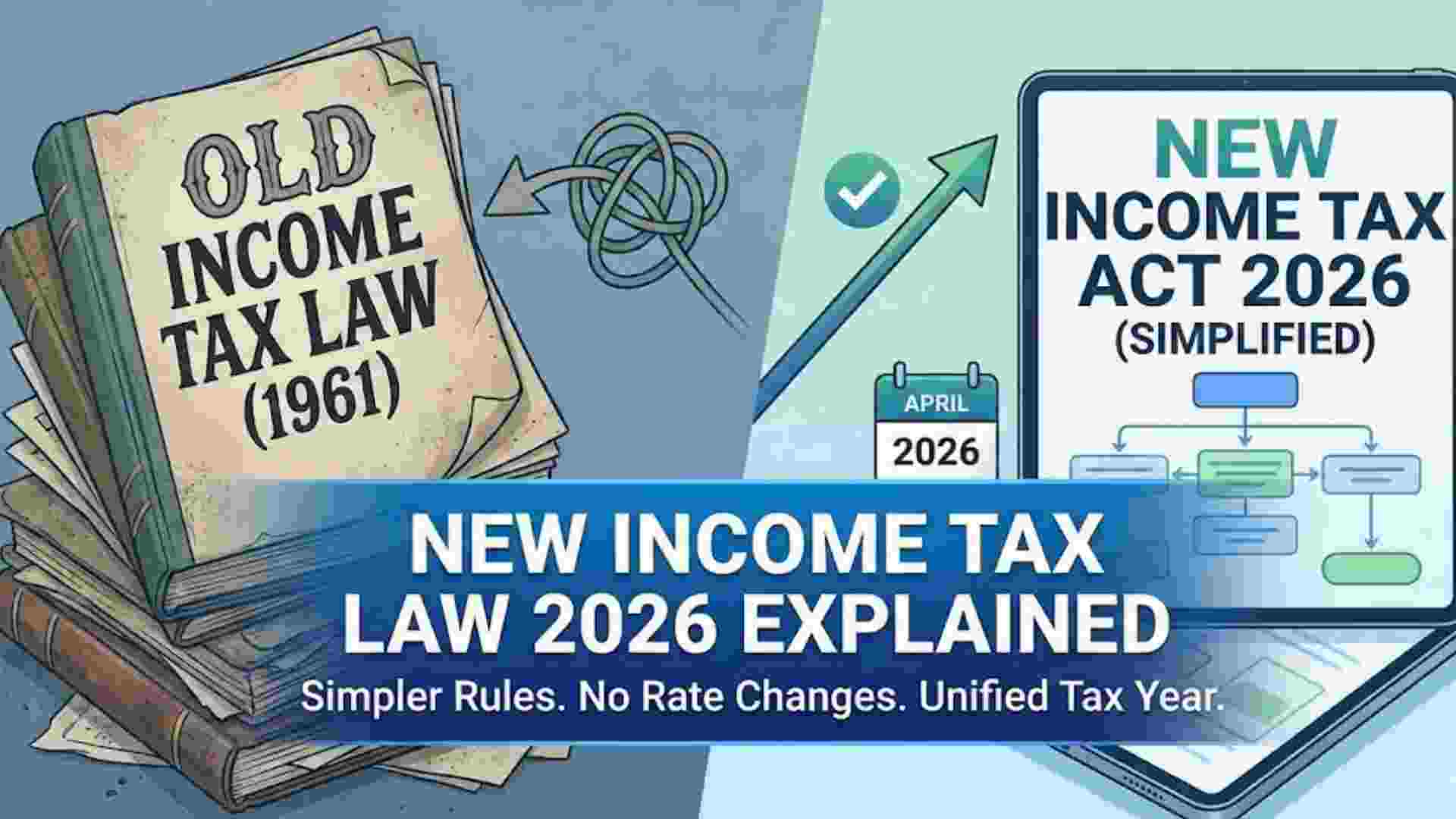
New Income Tax Law 2026 Explained: What Every Indian Taxpayer Needs to Know India's tax code just got its biggest makeover in 60 years. The New Income Tax Law 2026 replaces the old 1961 law — a bloated, 819-section document that took a CA just to decode — with something far leaner, clearer, and frankly, long overdue. It kicks in from April 1, 2026. Here's everything that actually matters, without the legal maze.
Why the Old Law Had to Go The 1961 Act started life as a reasonable piece of legislation. Six decades and thousands of amendments later, it had ballooned into 47 chapters, 819 sections, and thousands of pages of rules that even tax professionals struggled to navigate. Most ordinary taxpayers had no choice but to outsource their understanding entirely. The new Act fixes that. 536 sections. 23 chapters. 16 schedules. Plain language throughout. Clear tables for rates, TDS limits, salary perquisites, and allowances. The goal isn't to collect more tax — it's to make compliance something a reasonably informed person can actually manage. When Does It Apply? Period Governing Law Income up to March 31, 2026 Income Tax Act, 1961 Income from April 1, 2026 onwards Income Tax Act, 2025
The new law applies to all taxpayers — individuals, HUFs, companies, non-residents, and cooperatives. Draft rules and updated ITR forms are already available, giving you time to prepare before the switch.
You Can Also Read: 6 Pillars of Growth in India’s Budget 2026: A Strategic Blueprint for the Future
The Biggest Change: "Tax Year" Replaces Two Confusing Terms Gone are "previous year" and "assessment year" — two terms that tripped up taxpayers for decades. The new Act uses a single, clean concept: "Tax Year", running straight from April 1 to March 31. File for Tax Year 2026-27. Done. No more mental gymnastics about which year you're actually assessing.
Tax Slabs — Nothing Changes Let's get this out of the way immediately. No tax rate increases. No slab changes. Finance Minister Nirmala Sitharaman confirmed this explicitly for FY 2026-27. The new regime remains the default.
Income Slab (₹) Old Regime Rate New Regime Rate Up to 3,00,000 Nil Nil 3,00,001 – 7,00,000 5% 5% 7,00,001 – 10,00,000 20% 10% 10,00,001 – 12,00,000 30% 15% 12,00,001 – 15,00,000 30% 20% Above 15,00,000 30% 30%
Key points to remember: Resident individuals earning up to ₹12 lakh effectively pay zero tax under the new regime due to the Section 87A rebate Salaried individuals with gross salary up to ₹12.75 lakh are also effectively tax-free Senior citizens (60–80 years) retain a ₹3 lakh basic exemption under the old regime Super seniors (80+) retain a ₹5 lakh exemption Surcharge and cess remain unchanged You can opt out of the new regime annually Major Changes That Actually Affect You MAT Reduction for Companies The Minimum Alternate Tax rate drops from 15% to 14% for domestic companies and non-residents. Existing MAT credits can be set off at up to 25% of liability per year under the new regime. Buyback of shares is now taxed as capital gains rather than dividends — with corporates facing a 22% effective rate and others facing 30%.
TDS and TCS — More Cash in Your Hands Several TCS rates are reduced to improve cash flows:
Foreign tour packages — now a flat 2% (down from previous higher rates) LRS remittances for education and medical purposes — 2% Interest income TDS threshold for senior citizens doubled from ₹50,000 to ₹1,00,000 No TDS on Motor Accident Claims Tribunal interest payments Allowances and Perquisites — Long-Overdue Inflation Adjustments The old limits were embarrassingly outdated. The draft rules fix that:
Allowance / Perquisite Old Limit New Limit Children's Education ₹100/month/child ₹3,000/month/child Hostel Allowance ₹300/month/child ₹9,000/month/child Free Meals ₹50/meal ₹200/meal Non-Cash Gifts ₹5,000/year ₹15,000/year Car Lease (under 1.6L cc) ₹1,800 + ₹900/month ₹5,000 + ₹3,000/month Overseas Medical Treatment Tax-free if income < ₹2L Tax-free if income < ₹8L
These aren't radical reforms — they're practical corrections that should have happened years ago.
PAN Thresholds Revised Quoting your PAN is now mandatory at higher transaction values:
Property transactions: ₹10 lakh → ₹20 lakh Hotel cash payments: ₹50,000 → ₹1 lakh Vehicle purchases above ₹5 lakh (including motorcycles) Compliance Gets Simpler ITR filing deadline for non-audit cases proposed to extend to August 31 Revised returns allowed within 12 months with nominal fees Minor penalties decriminalized Unexplained income taxed at 30% — down sharply from the earlier effective rate of ~83% One-time disclosure window for undisclosed foreign assets up to ₹5 crore with reduced penalty and prosecution immunity AI-enabled risk assessments introduced for greater transparency New Exemptions Worth Noting Foreign companies get exemptions on data center services income until 2046-47 Non-residents can benefit from a 5-year global income exemption under notified schemes Cooperatives get deductions for cattle feed and cottonseed plus a 3-year dividend exemption IFSC units taxed at 15% post-holiday period Critical mineral exploration expenses amortized over 5 years Transfer Pricing Updates IT services safe harbour margin set at 15.5%, threshold raised to ₹2,000 crore New 15% safe harbour rate for data centers Advance Pricing Agreements fast-tracked with a 2-year target resolution Read More About: https://getswipe.in/blog/article/highlights-of-income-tax-bill-2025
Who Benefits and How Taxpayer Group Key Benefit Salaried Individuals Higher allowances, ₹12L effective zero-tax threshold, extended filing deadline Companies & Businesses MAT reduction, manufacturing and tech incentives Non-Residents / NRIs New exemptions encouraging investment (note: Section 87A rebate doesn't apply to NRIs) Cooperatives & Farmers Expanded deductions supporting rural economy MSMEs Simplified compliance, lower administrative burden
Conclusion The New Income Tax Law 2026 doesn't take more from you. It just makes the system work better — shorter, clearer, and far less dependent on expert intermediaries to understand. Your tax rates stay the same. Your allowances get updated for inflation. Your compliance burden gets lighter.
Since the new rules kick in from April 1, 2026, now is the right time to review the draft rules and updated ITR forms on the Income Tax India website and speak with your CA about what changes before the transition date.
People Also Ask When does the new law actually start? April 1, 2026. Income earned before that date follows the 1961 Act.
Do my tax rates change? No. Slabs and rates are identical for FY 2026-27.
What exactly is the "Tax Year"? One unified period — April 1 to March 31 — replacing the old "previous year" and "assessment year" confusion.
Is the new law really shorter? Yes. 536 sections vs 819. 23 chapters vs 47. Plain language throughout.
Should I switch to the new regime? If you have few deductions or exemptions, the new regime almost certainly saves you money. Consult a CA for your specific situation.
.png)
-compressed.jpg)
.jpg)


.png)
.png)
.png)
.png)