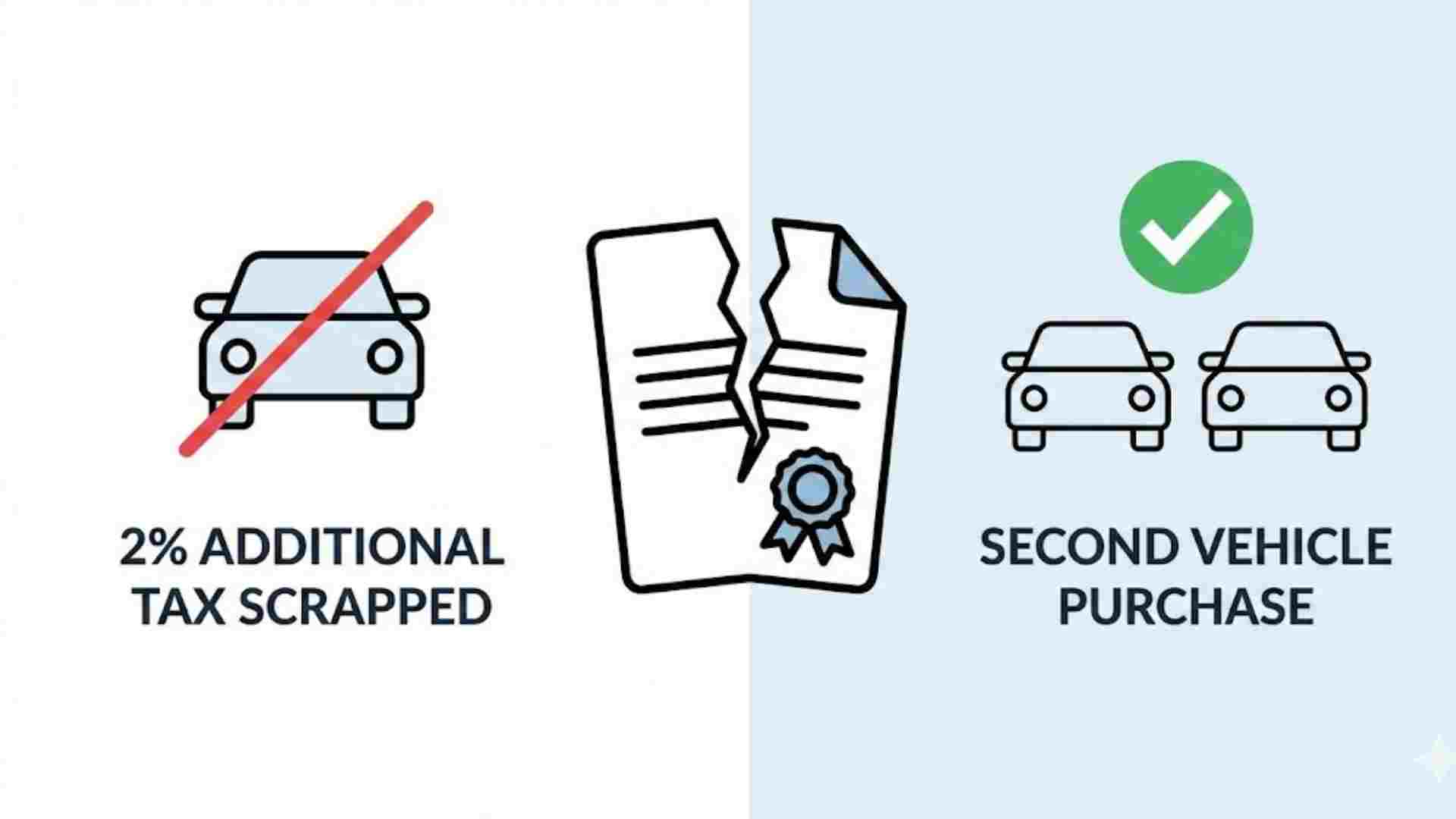
Telangana Govt to Scrap 2% Additional Life Tax on Second Vehicle Purchase | Latest Update In a development which is likely to finally provide some much-needed respite to thousands of middle-class families in the state, the Telangana government is all set to waive the additional 2% life tax that has to be paid while purchasing a second car. According to reports, Telangana Chief Minister A. Revanth Reddy has given his nod to a proposal submitted by the Transport Department , and the orders are likely to be issued in the coming days. This comes at a time when the cost of living and car ownership is rising and taking its toll on families. How the 2% Life Tax Works The additional tax, also known as surcharge, has been in practice for some years now and is only applicable to those people who already have one vehicle registered in their name and are now registering a second one, which could be a two-wheeler, car, or any other type of non-transport vehicle. According to the existing system, the buyers are supposed to pay the standard life tax, which is a one-time registration fee charged on the basis of the vehicle's price, along with an additional 2% of the vehicle's price for all subsequent purchases. In this manner, it seems like an extra burden on those people who require an additional means of transport.
Category Existing Rule After Proposed Waiver Estimated Savings Applicability Charged on purchase of second vehicle (if one vehicle already registered in buyer’s name) No additional 2% charge on the second vehicle Full 2% cost saved Two-Wheeler Example ₹1.20 lakh vehicle → ₹2,400 extra No surcharge ₹2,400 Four-Wheeler Example ₹10 lakh vehicle → ₹20,000 extra No surcharge ₹20,000 Annual Revenue to State ₹80–100 crore collected through surcharge Revenue discontinued ₹80–100 crore impact System Integration Manual cross-checking due to VAHAN limitations Simplified registration process Faster RTO processing Beneficiaries Second vehicle buyers (middle-class families, urban & rural households) Same group benefits directly Lower ownership cost
Cost Impact on Families For instance, consider a normal purchase in Tier-1 cities such as Hyderabad and Tier-2 cities such as Warangal and Nizamabad. A middle-class family would buy a basic two-wheeler, which would cost them approximately ₹1.20 lakhs. According to the current norms, they would have to shell out an additional ₹2,400 (2% of ₹1.20 lakhs) as the life tax if it is their second car. Although ₹2,400 may not be a substantial amount, it can quickly add up if calculated in terms of sales in the lakhs every year. For four-wheelers, the difference would be substantial—a mid-range sedan costing between ₹8-10 lakhs would mean an additional payment of ₹16,000-20,000.
Revenue Implications As estimated by the transport department, the state gets between ₹80 crore and ₹100 crore annually from this surcharge. This amount has contributed to the development of road infrastructure and other related projects, but the government now believes that the overall benefits of the removal of this surcharge are more important than the financial aspect of it. The removal of this surcharge will enable the government to make car ownership easier and encourage people to register their vehicles in compliance without any deterrents.
VAHAN System Issues Apart from the monetary implication, this decision also resolves the practical issues that have been existing in the process of implementation. Telangana has been synchronizing its processes with the national VAHAN system —a common database for vehicle registration services, which is managed by the Ministry of Road Transport and Highways. The VAHAN system, which is standardized across all states, does not have the capability to support differential taxation based on the number of ownerships (for example, an additional charge for the second vehicle). The process of checking if the buyer already owns a vehicle involves cross-checking, which has been resulting in delays and hassles at the RTOs.
The news has already brought a positive reaction from the citizens. The commuters in Hyderabad, where traffic congestion is a problem that makes it necessary for many families to have multiple vehicles, have welcomed the news with open arms. "It's about time," said Ramesh Kumar, a software professional from Kukatpally who owns one bike and has been planning to buy a second one for his wife. "That extra 2% felt like double taxation for no reason at all. This will make life easier for families like mine." This is the reaction in rural and semi-urban areas, where two-wheelers are a lifeline for commutes to work, school, or mark.
Conclusion Of course, the loss of revenue, estimated to be around ₹80-100 crores a year, would have to be compensated in some other manner, but it seems that the benefit of public satisfaction would make this decision worthwhile. The Transport Department has been considering such proposals for months, and the clearance from the Chief Minister is a definite step ahead.
As the orders are finalized and the transition process begins, car buyers in Telangana can now look forward to a hassle-free and cheaper registration process. Another thing to cross off the list when buying that second bike or car.
People Also Ask What is the 2% life tax that has been waived off? It is an additional 2% tax that has to be paid only when purchasing a second vehicle if the purchaser already owns a vehicle. This is in addition to the life tax that has to be paid for every new purchase.
When will this change come into effect? The proposal has been cleared by the Chief Minister, Revanth Reddy, and the orders are expected from the Transport Department shortly. Once the orders are out, the waiver will come into effect.
Who will benefit from this decision? Middle-class families, people purchasing a second vehicle for their family members (spouse, children, or elderly parents). This applies to two-wheelers, cars, and other non-transport vehicles.
How much will buyers save? This depends on the cost of the vehicle. For a two-wheeler costing ₹1.20 lakh, the buyer saves ₹2,400. For a car costing ₹10 lakh, the buyer saves ₹20,000. This makes second vehicles more economical.
Will the government lose a lot of revenue? The surcharge raises ₹80-100 crore every year. Although this is a loss, the government feels that this is trumped by the lessened burden on the public, ease of administration, and integration with the national system, VAHAN.
Why was this tax imposed in the first place? It was meant to raise more funds for the development of roads and prevent people from owning multiple vehicles in congested regions. But due to some problems in its implementation and feedback, it has been reconsidered.
Does this affect people who already own vehicles or just new ones? It will affect new registrations of second vehicles. There will be no effect on vehicles that are already registered with the surcharge.
Are there similar taxes in other states? Most states do not have this surcharge on second vehicles, which is why this decision has been made. Telangana's decision brings it in line with the rest of the country.
Will this affect vehicle sales in Telangana? It may lead to an increase in registrations, especially of second vehicles, which will have a slight positive effect on the automobile industry.
.png)
-compressed.jpg)
.jpg)


.png)
.png)
.png)
.png)